
Vonage Verify is a good option for businesses that need to send and verify OTPs via SMS, WhatsApp, and voice without building the entire verification system themselves.
However, for applications serving users across multiple markets, verification costs can vary significantly by destination, delivery channel, and number of attempts required.
Depending on your verification volume and the countries you serve, you may need a different pricing model or a more cost-effective way to deliver OTPs from a provider that automatically selects the lowest-cost eligible channel, handles fallback, and gives you better visibility into delivery performance and costs.
In this article, we’ll share how our own OTP verification platform, SecondFactor, addresses these requirements, then cover seven other Vonage Verify alternatives whose names we often see come up.
1. SecondFactor
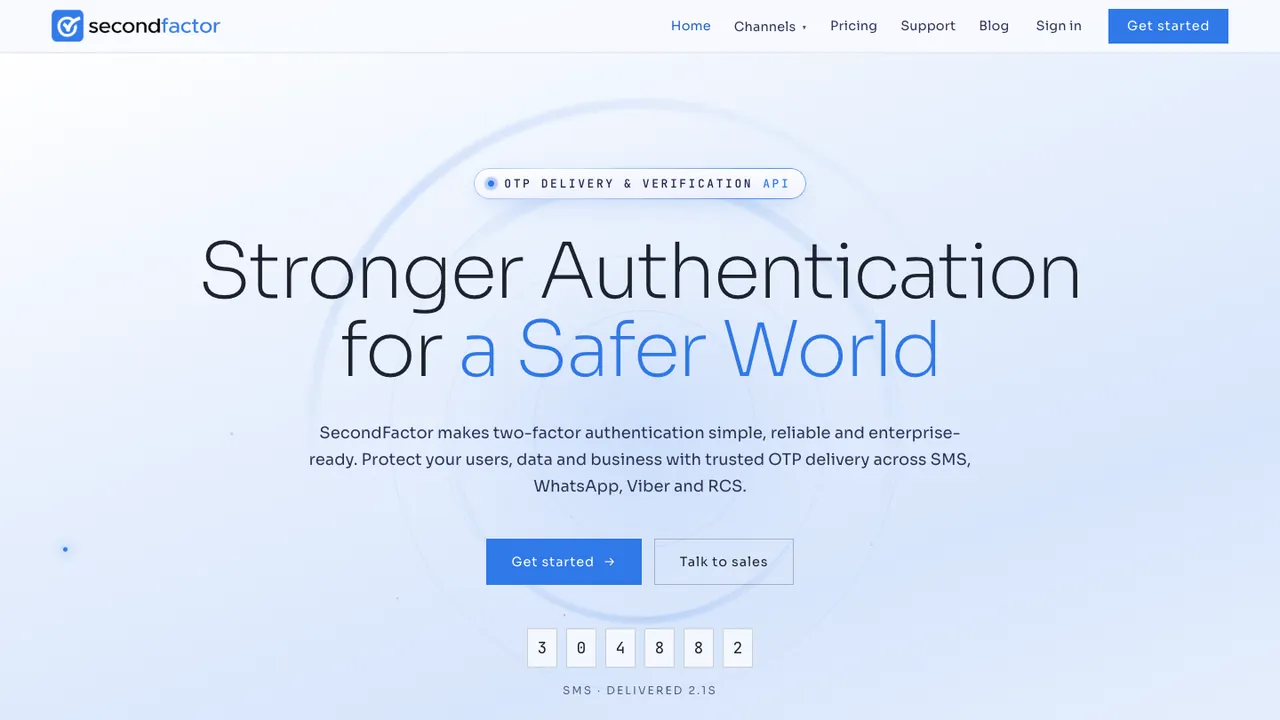
At SecondFactor, we help businesses send and verify OTPs across SMS, WhatsApp, Viber, and RCS through one API.
We built our platform for applications serving users across countries where channel availability, delivery costs, and verification requirements vary significantly.
Our Price Intelligence Engine (PIE) automatically selects the lowest-cost eligible delivery channel for each OTP request and handles fallback when delivery isn’t confirmed.
We also manage OTP generation, verification, and delivery tracking, so your developers don’t need to build and maintain these systems separately.
Send and Verify OTPs With One API Integration
With SecondFactor, your application only needs two API calls to send and verify an OTP.
When a user requests a verification code, your application sends their phone number to our POST /v2/Services/{ServiceSid}/Verifications endpoint. We generate the OTP, select the delivery channel, and send the code to the recipient.
When the user enters the code, your application submits it through POST /v2/Services/{ServiceSid}/VerificationCheck, and we validate it and return the verification result.
The same integration works across SMS, WhatsApp, Viber, and RCS. You can enable additional channels without changing how your application sends or verifies OTPs.
Automatically Select the Lowest-Cost Eligible OTP Channel
Our Price Intelligence Engine evaluates the delivery options for each OTP request rather than relying on a fixed channel sequence.
PIE identifies the destination country and operator, checks which channels are available and eligible for the recipient and your account, and ranks those options by cost.
For example, if WhatsApp is available and costs less than SMS for a particular destination, PIE can attempt WhatsApp first. For another country or recipient, SMS, Viber, or RCS may be cheaper.
This helps businesses reduce verification costs across markets without maintaining country-specific channel-selection rules.
Fall Back Automatically When OTP Delivery Isn’t Confirmed
A lower-cost delivery channel isn’t useful if the recipient never receives the verification code.
If the initial channel doesn’t confirm delivery within eight seconds, SecondFactor automatically attempts the next eligible channel.
For example, PIE may initially select WhatsApp because it costs less to deliver. If the OTP doesn’t receive delivery confirmation, the platform can fall back to SMS when that channel is available.
We handle this process within the same verification request, so your developers don’t need to implement separate fallback logic or trigger another delivery attempt themselves.
Manage OTP Channels and Authentication Templates
You can enable the delivery channels you need and manage their configurations through SecondFactor.
Some channels require additional setup before they can be used. For example, WhatsApp OTP delivery requires a connected WhatsApp Business Account and approved authentication templates. Viber and RCS may also require business sender registration and approval.
Our dashboard lets you create authentication templates and track their approval status.
Once your channels are configured and eligible, PIE can route messages automatically and provide fallbacks without separate API integrations.
Track OTP Delivery Status and Verification Costs
Our OTP logs give you visibility into how we handled each verification request.
You can review the recipient’s phone number, destination country, selected delivery channel, delivery status, and cost.
If a user reports that an OTP never arrived, your team can check which channel was attempted and whether delivery was confirmed.
You can also review delivery costs across different markets to understand how your verification traffic is being routed.
These records are available in one dashboard across the supported channels.
Test OTP Routing and Verification Before Integrating
We also offer a PIE Playground where you can test the complete OTP delivery and verification process before writing any integration code.
Enter a recipient’s phone number, send a real OTP, and see which delivery channel PIE selected. The Playground also shows whether a fallback occurred and lets you enter the received code to complete verification.
New accounts receive free credits to test the platform with their configured channels.
You can create a SecondFactor account to try the PIE Playground or contact our team to discuss verification requirements and pricing for the countries you serve.
2. Twilio Verify
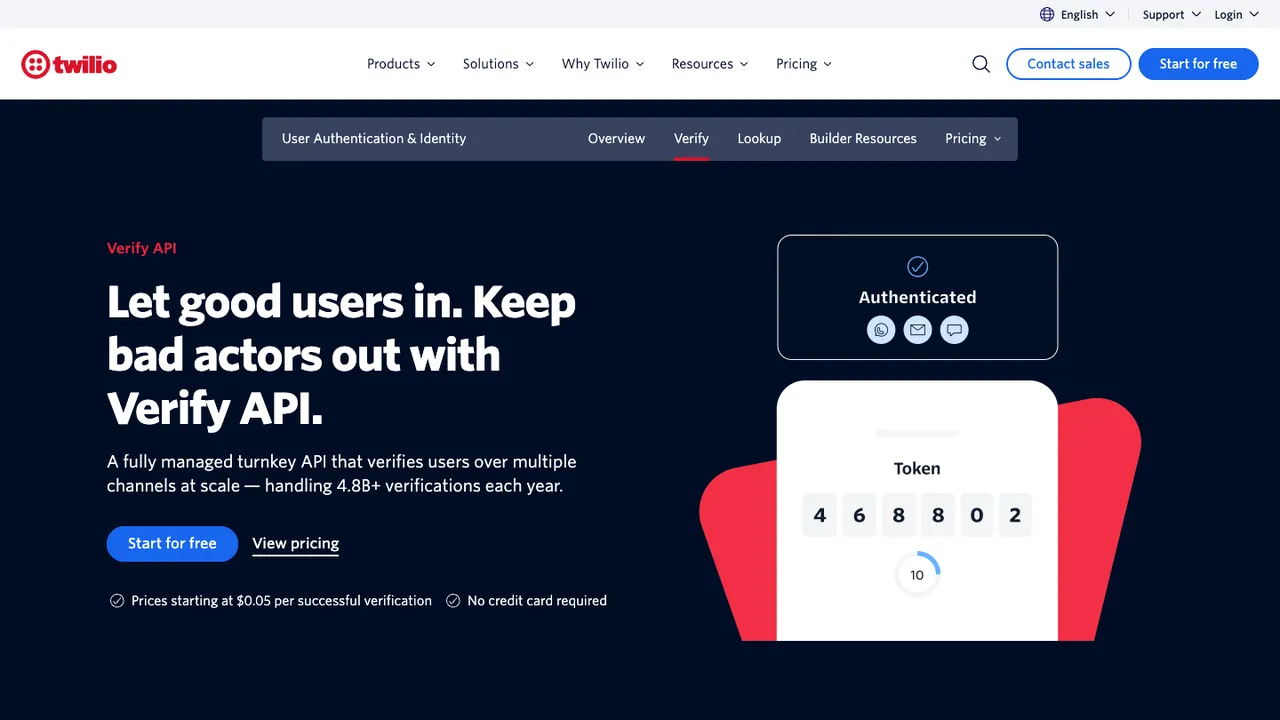
Twilio Verify is a managed verification API that businesses can use to verify users during registration, login, account recovery, and other sensitive actions.
It supports OTP delivery via SMS, WhatsApp, voice, and email, plus authentication methods such as TOTP, push notifications, and Silent Network Authentication (SNA).
Twilio handles OTP generation, expiration, and validation through its Verify API. It also provides built-in rate limiting, Fraud Guard to help prevent SMS pumping fraud, and reporting tools to monitor verification attempts and conversion rates.
Businesses can configure verification channels and use supported fallback workflows. It also offers channel optimization features, although some require additional configuration or access.
Twilio Verify uses a pay-as-you-go pricing model starting at $0.05 per successful verification, plus applicable delivery charges. SMS and other channel charges may still apply when a user doesn’t complete verification.
3. Telesign Verify
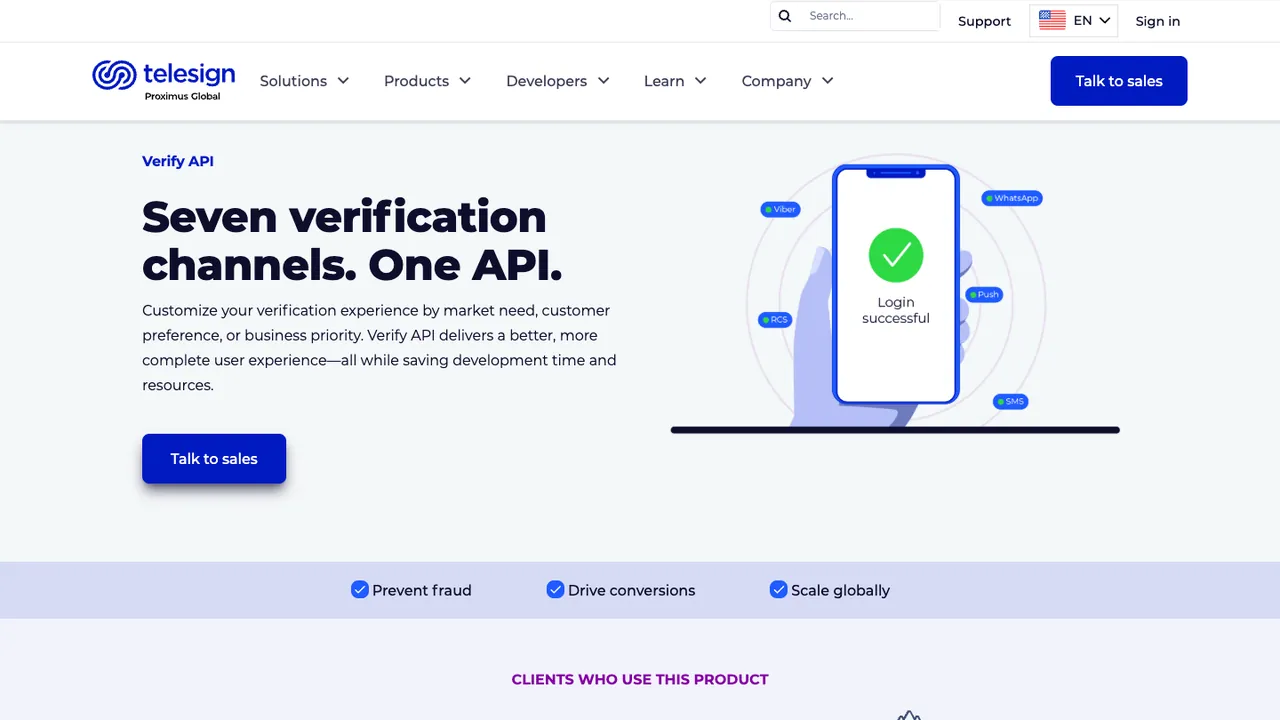
Telesign Verify is a multichannel verification API designed for businesses that need to authenticate users across different countries and communication channels.
Its Verify API supports OTP verification through SMS, WhatsApp, Viber, RCS, email, and voice. Telesign also offers Silent Verify, which uses mobile network information to verify phone number ownership without requiring users to enter a code.
Telesign can generate and validate OTPs or allow developers to supply their own verification codes. Businesses can configure verification policies that determine which delivery channels to use and when to fall back to another method.
For example, you can configure WhatsApp as the primary verification channel for a particular country and SMS as the backup. The platform also supports country-specific routing rules and configurable fallback times.
Telesign also offers additional fraud-prevention products that help businesses assess phone-number risk and identify potentially fraudulent users.
The multichannel Verify API is available to full-service accounts, but businesses must contact Telesign to enable it. Pricing depends on the services, channels, and markets involved, so you’ll need to request a quote to compare costs with other providers.
4. Infobip Authenticate
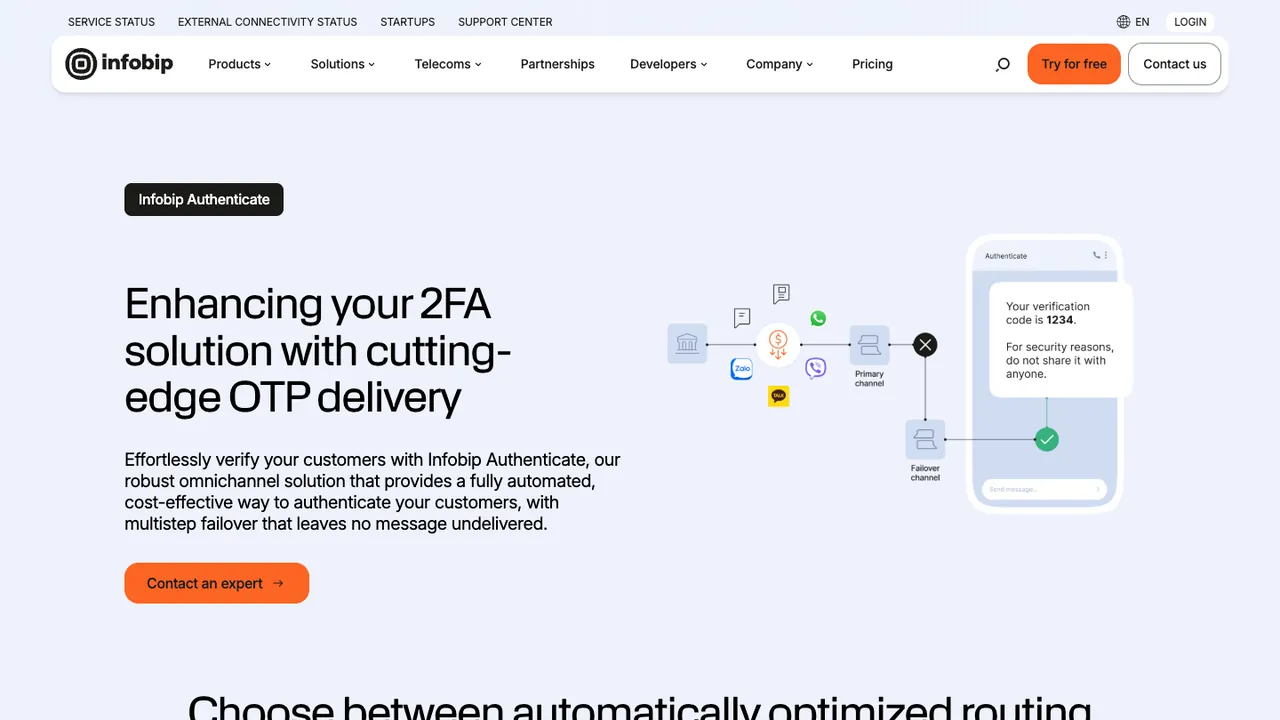
Infobip Authenticate is an omnichannel authentication solution that lets businesses send and verify OTPs via SMS, WhatsApp, RCS, Viber, email, and voice.
It offers automated channel selection and multistep failover to improve OTP delivery rates and manage verification costs across markets.
Infobip’s optimized routing can select a delivery channel for each recipient based on factors such as channel availability, cost, and delivery performance. If the initial delivery attempt fails, the platform can automatically attempt another supported channel.
The platform also provides a unified API for OTP delivery, tools for managing message templates and sender registrations, and analytics to monitor delivery rates and verification performance.
For fraud prevention, Infobip offers Signals, which helps businesses detect and block suspicious messaging traffic, including artificially inflated OTP traffic associated with SMS pumping fraud.
Infobip also provides a separate 2FA API to generate and validate PINs via SMS, voice, and email.
Infobip doesn’t publish a single standard price for its Authenticate solution. Businesses need to contact its sales team for pricing based on their verification volume, destinations, and required channels.
5. Sinch Verification
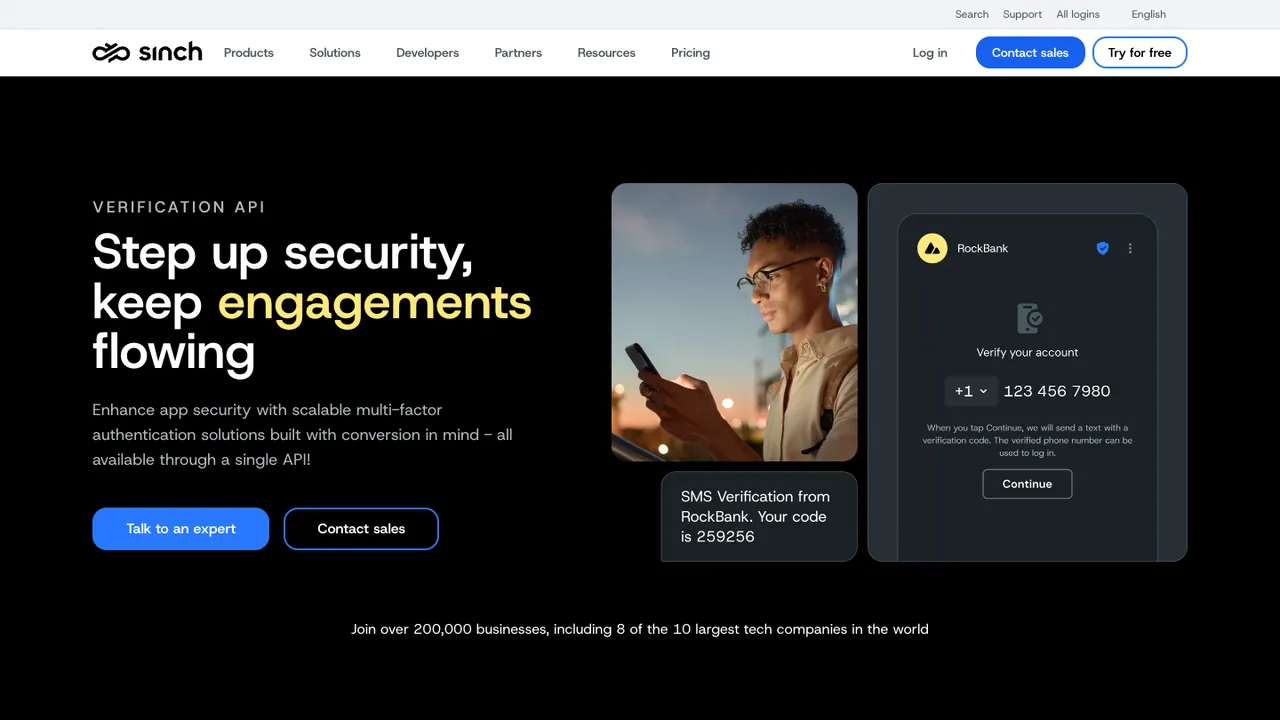
Sinch Verification is a phone number verification service that supports SMS, voice calls, FlashCall, and mobile network-based data verification.
Its Verification API handles the verification process, including generating codes, checking user responses, and reporting verification results. Developers can integrate it through REST APIs or SDKs for Android, iOS, and other supported environments.
One of Sinch’s distinguishing features is FlashCall verification, which uses a missed call instead of sending an SMS. The recipient’s phone number is verified using the incoming caller number, which the Android SDK can capture automatically. On iOS and web applications, users generally need to enter the calling number manually.
Sinch also offers data verification, which uses mobile carrier infrastructure to verify a phone number without requiring the user to enter an OTP. However, this method requires mobile data connectivity and is available only through supported networks.
Businesses can combine different verification methods and monitor delivery rates, verification success rates, and other performance metrics through the Sinch dashboard.
One consideration is that developers may need to implement logic to switch between methods when using the standard Verification API.
Sinch charges for verification requests, with pricing dependent on the verification method, destination country, and operator. Businesses can review available rates through the Sinch dashboard or contact its sales team for their specific requirements.
6. Bird Verify
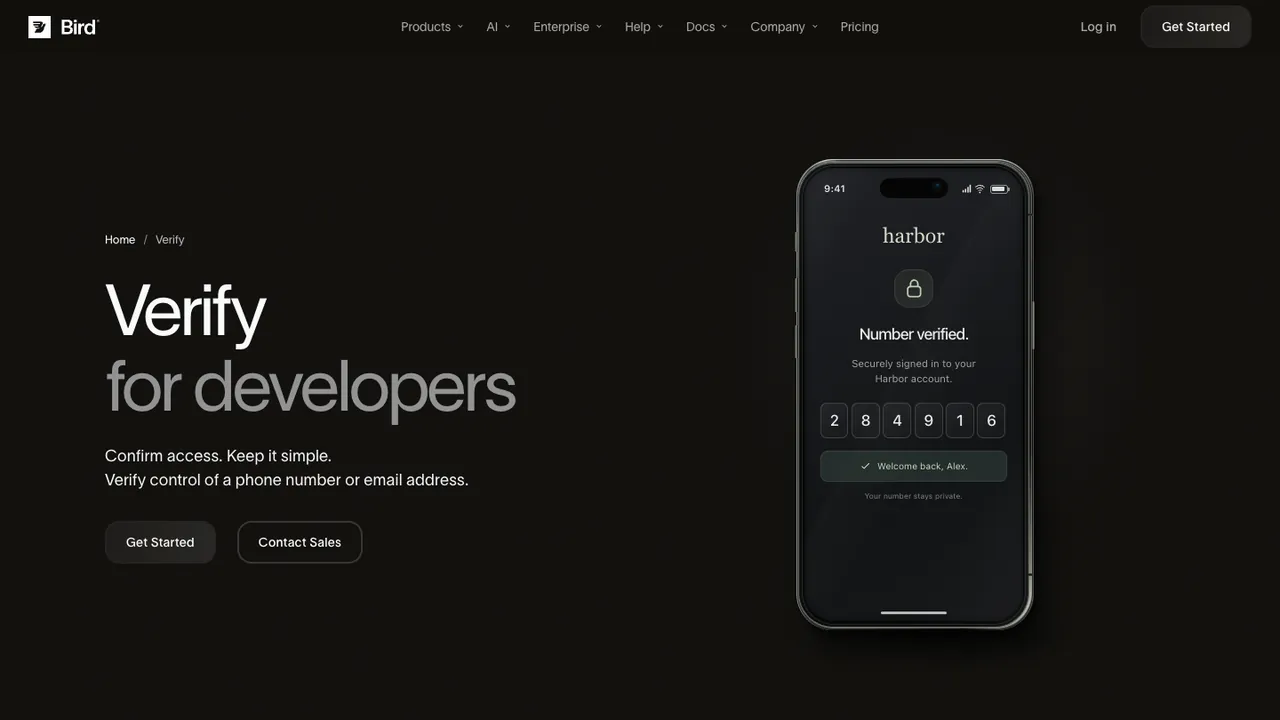
Bird Verify, formerly MessageBird, is a verification API that lets businesses send and validate OTPs via SMS, WhatsApp, and email.
The platform handles OTP generation, expiration, and validation through its API. Developers can create a verification request and check the user-entered code without storing a separate verification ID in their application.
Bird also supports country-specific channel configurations. Businesses can choose which channels to enable, set their preferred delivery order, and configure senders for different markets. For example, a business can prioritize WhatsApp in countries where it is suitable and use SMS as an alternative.
If a delivery attempt fails, Bird can move to the next configured channel. Developers can also request a switch to another eligible channel when users report that they haven’t received their codes.
For security, Bird provides configurable OTP expiration, resend cooldowns, verification attempt limits, and per-recipient rate limits to help prevent abuse.
Bird Verify doesn’t charge a separate verification fee. Businesses pay the applicable SMS, WhatsApp, or email delivery rates, with additional charges for resends and fallback messages.
7. Plivo Verify
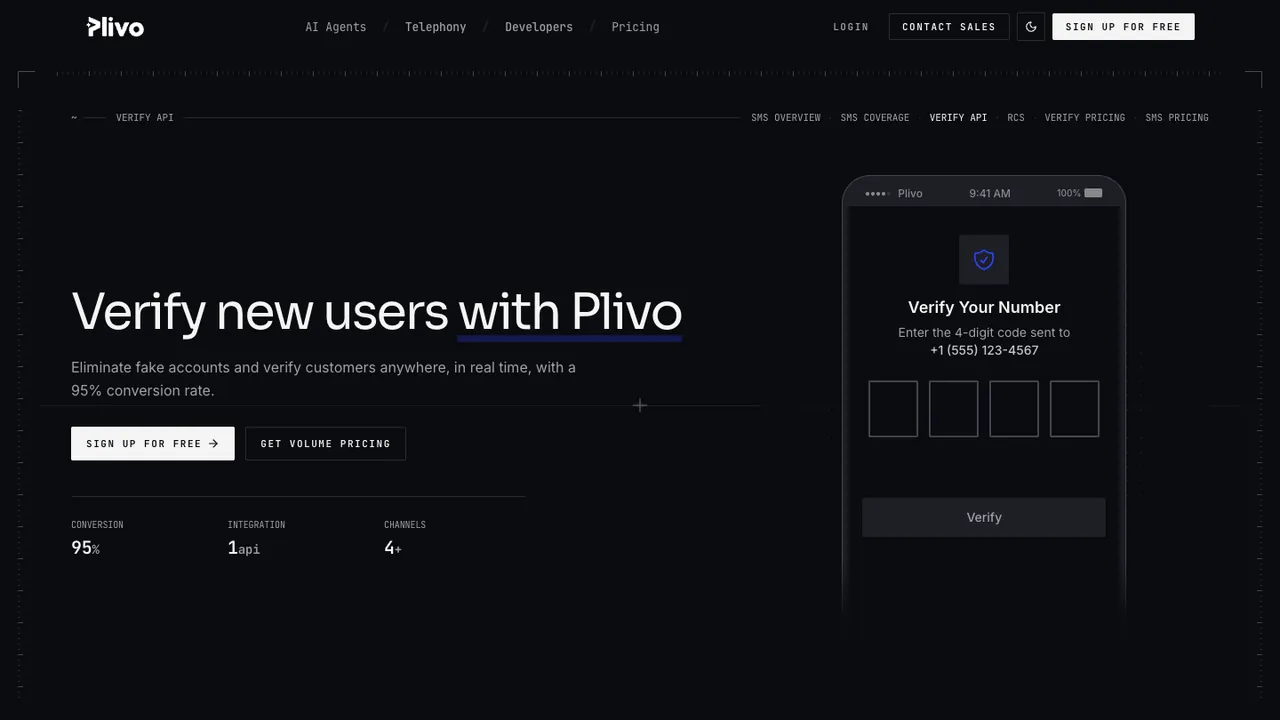
Plivo Verify is a managed OTP verification API that businesses can use to authenticate users through SMS and voice calls.
It handles OTP generation, delivery, expiration, and validation, reducing the work developers need to build around a basic messaging API.
Businesses can configure OTP length, expiration time, maximum delivery attempts, and message templates through the Plivo Console.
The platform also supports delivery status callbacks and verification logs that show the recipient, destination country, verification status, number of attempts, and total session cost.
Plivo includes Fraud Shield, which monitors verification traffic for suspicious activity and helps prevent SMS pumping attacks. Businesses can adjust the level of protection based on their risk tolerance.
For applications that require multiple verification methods, developers can implement workflows that retry an OTP through a voice call if SMS delivery fails.
Plivo doesn’t charge a separate OTP verification fee, and Fraud Shield is included at no additional cost. Businesses pay the applicable delivery costs based on the channel and destination.
However, Plivo Verify isn’t available through standard self-service onboarding. It requires a minimum monthly commitment of $1,000 for eligible markets, while access to countries requiring sender or template pre-registration generally requires a $10,000 monthly commitment.
8. Telnyx Verify
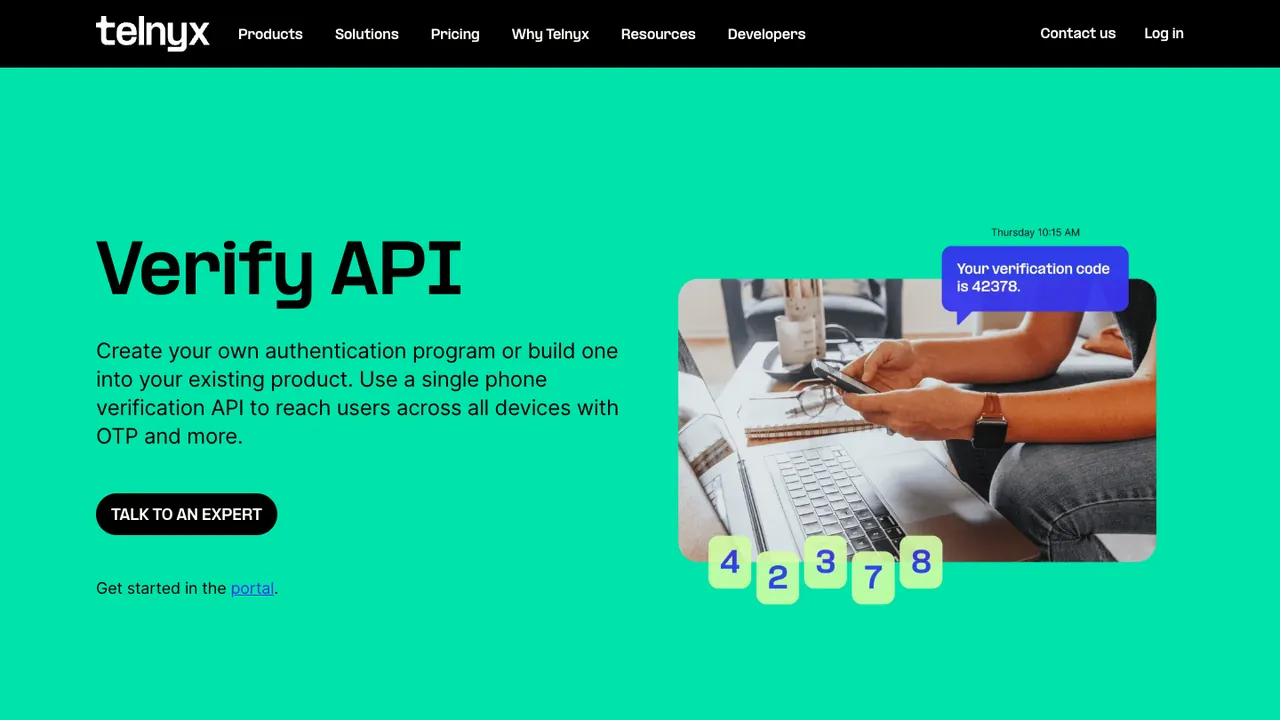
Telnyx Verify is a phone verification API that lets businesses authenticate users via SMS, voice calls, flash calls, and WhatsApp.
The platform handles OTP generation, delivery, expiration, and validation through its API. Developers can create verification profiles to configure code expiration, delivery methods, and other settings for their applications.
Telnyx supports verification across more than 190 country codes and provides delivery reports and webhooks to help businesses monitor verification activity.
Businesses can choose their preferred verification methods and build fallback workflows across supported channels. However, developers should evaluate the additional work required to manage channel selection, retries, and fraud prevention.
Telnyx publishes its Verify API pricing, starting at $0.03 per successful verification, plus applicable SMS, voice, flash-call, or WhatsApp delivery charges.
It also offers pay-as-you-go access with no monthly minimum commitment.
What to Consider When Choosing a Vonage Verify Alternative
Vonage Verify already supports multiple verification channels, configurable workflows, and automatic fallback.
When comparing alternatives, you should look beyond the list of supported features and evaluate how each provider handles verification costs, delivery, fraud prevention, and implementation.
1. Total Cost per Successful Verification
OTP providers use different pricing models. Some charge a fixed fee per successful verification plus messaging costs, while others charge only for messages or verification attempts.
Verify Conversion charges a successful-verification fee plus applicable channel usage charges. Verify Success uses negotiated pricing where businesses generally pay for completed verifications rather than individual delivery attempts.
When comparing providers, calculate your cost per successfully verified user rather than just the price of sending one OTP.
Include the costs of unsuccessful attempts, resends, fallback messages, and any additional verification fees. These can make a significant difference when you’re processing thousands or millions of verifications each month.
2. Channel Selection and Automatic Fallback
Most managed OTP verification providers support multiple delivery channels, but they differ in how they choose which one to use.
Vonage lets developers define verification workflows that specify the channel order and when to move to the next option. Other providers may offer dynamic routing that considers channel availability, pricing, or delivery performance for each request.
If your application serves users in multiple countries, look for a provider that can automatically select the most cost-effective eligible channel rather than requiring you to maintain different routing rules for every market.
Also check what triggers fallback, how long the provider waits before trying another channel, and whether additional delivery attempts incur charges.
3. Coverage and Delivery Performance in Your Target Markets
A provider may advertise global coverage, but that doesn’t mean every verification channel works equally well in every country.
SMS delivery can vary by carrier and destination. WhatsApp, Viber, and RCS availability depends on the recipient and each channel’s requirements.
Some countries also require businesses to register sender IDs, messaging templates, or other information before they can send authentication messages.
Before switching providers, confirm that they support your main destination countries and the channels you plan to use.
If possible, test OTP delivery with real phone numbers across your highest-volume markets and compare delivery rates, verification completion rates, and costs.
4. Fraud Protection and Verification Security
OTP verification systems can be targeted by SMS pumping attacks, where fraudsters generate large volumes of verification requests to expensive destinations. Attackers may also repeatedly request codes, abuse resend features, or attempt to guess OTPs.
Look for providers that offer rate limiting, suspicious traffic detection, country restrictions, OTP expiration, and limits on failed verification attempts.
Vonage already includes fraud prevention capabilities through Fraud Defender, so compare alternative providers’ protections rather than assuming they will be more secure.
You should also check which security controls the provider manages automatically and which ones your developers must configure within your application.
5. API Integration and Migration Requirements
If your application already uses Vonage Verify, switching providers will require changes to your verification integration.
Compare how each provider handles OTP requests, verification sessions, code validation, expiration, delivery callbacks, and retries.
Some providers offer a single API to send and verify codes across channels, while others require separate configurations or extra logic for specific delivery methods.
You’ll also need to update the parts of your application that handle verification errors, session tracking, and user-facing messages.
Before migrating all your traffic, test the new provider with a small portion of your verification requests so you can compare completion rates, delivery times, and costs while confirming that your signup, login, and account recovery workflows still work correctly.
Reduce Your OTP Verification Costs With SecondFactor
Vonage Verify is a capable OTP verification service, but depending on your verification volume, destination countries, and delivery requirements, another provider may offer a more cost-effective solution.
At SecondFactor, we help businesses reduce OTP verification costs by automatically selecting the lowest-cost eligible channel across SMS, WhatsApp, Viber, and RCS. Our platform also handles fallback, OTP generation and validation, and delivery tracking through one API.
If you’re considering moving away from Vonage Verify, you can try our PIE Playground to see how SecondFactor routes OTPs for your target markets.
Get started with SecondFactor or contact our team to discuss your verification requirements.