
In our experience, most OTP providers require you to configure channel selection, retries, and failure-handling workflows yourself, which takes significant upfront development time, increases costs, and makes it harder to expand into new markets quickly.
Depending on the provider, you may also pay per message plus a separate verification fee. Delivery rates vary by market, so keeping costs down can require ongoing adjustments to which channel you use for each destination.
For apps and websites serving multiple markets, you need users in each country to receive their codes reliably without paying for a more expensive channel when a suitable lower-cost option is available.
In this article, we’ll share how SecondFactor addresses these problems, then cover six other OTP service providers whose names we often see come up.
1. SecondFactor
We built SecondFactor for teams that need to verify users across multiple markets without maintaining separate delivery workflows for each one.
Our platform sends and verifies OTPs via SMS, WhatsApp, Viber, and RCS through a single API, with automatic channel selection and fallback built in.
Send and Verify OTPs With Two API Calls
With SecondFactor, your application makes one API call to request a code and another to verify the user’s entry.
The first request, POST /otp/send, submits the user’s phone number. We generate the code, choose an eligible delivery channel, and return a request ID.
Your application then submits the user’s code through POST /otp/verify, and we return the verification result. Your backend does not need to generate, store, or independently validate the OTP.
Your developers integrate those requests into your signup or login flow, while we handle the delivery decisions behind them.
As you activate additional channels, you can continue using the same send-and-verify integration rather than building a separate workflow for each channel.
Automatically Select the Lowest-Cost Eligible Channel
If you use the same delivery sequence for every country, you’ll pay for a more expensive channel when a suitable lower-cost option might be available. Our Price Intelligence Engine, or PIE, evaluates each request instead of relying on one fixed sequence.
PIE identifies the destination country and operator from the phone number, checks which channels are available and eligible for your account, and ranks those options by cost. It then attempts delivery through the lowest-cost eligible channel.
For example, when WhatsApp is an eligible, lower-cost option for a request, PIE can try it before SMS. For another destination, it may choose a different channel.
With SecondFactor, your developers do not have to maintain those country-by-country routing decisions themselves.
Try Another Channel Automatically When Delivery Is Not Confirmed
When the initial channel does not confirm delivery, SecondFactor automatically moves to the next eligible option. Your developers don’t need to write logic to detect the missing confirmation and switch channels for that request.
For example, a low-cost messaging channel may not reach a recipient who does not have that app installed.
Instead of leaving the request on that channel, PIE can move it to another available option. This gives the code another delivery route without relying on the user to repeatedly request it through the same channel.
Check Delivery Status and Costs in One Place
When a user reports that their code never arrived, you need to see how the request was handled.
SecondFactor’s OTP logs record the recipient’s phone number and country, delivery channel, status, and cost. You can review those details across channels in the same reporting area.
You can also test the process in the PIE Playground. Enter a recipient number, choose a template, and send a real OTP to see which channel PIE selected and whether it used a fallback.
Then enter the code you received to test the complete send-and-verify flow before adding it to your application.
To get started, create an account, complete the setup for your chosen channels, and submit your OTP template. Some channels require approval before they’re available for routing; once eligible, PIE handles channel selection and fallback through your existing integration.
Create your SecondFactor account to test an OTP, or contact our team to discuss pricing for your target markets.
2. Twilio Verify
Twilio Verify supports OTP delivery through SMS, WhatsApp, voice calls, and email. It also offers authenticator-app codes and push approvals, making it worth considering when your application needs authentication options beyond phone-based OTP delivery.
Twilio handles sending and checking verification codes through its API, with helper libraries for languages including JavaScript, Python, PHP, and Java.
Twilio also offers Fraud Guard, which is enabled by default and analyzes SMS traffic for suspicious patterns. When it detects potential SMS pumping, it can block messages to the affected number prefixes.
Your team can adjust the protection level and investigate blocked requests through the console. This protection applies to SMS, rather than every verification channel.
Twilio also handles some channel selection and fallback automatically. For example, its RCS Upgrade feature is enabled by default and can switch an SMS verification request to RCS where supported, with SMS fallback available.
Other configurations require more involvement: to prioritize WhatsApp in particular countries, you need a working WhatsApp sender and must coordinate with Twilio’s Verify team.
Twilio’s standard rate is US$0.05 per successful verification, plus the applicable channel charges. Its published US SMS rate is an additional US$0.0083 per message.
The verification fee is therefore only one part of the cost; your destination rates and the number of messages sent also affect your bill. Volume-based pricing is available through sales.
3. Vonage Verify
Vonage Verify gives teams control over the sequence of channels used to verify a user. Its supported options include SMS, RCS, WhatsApp, voice, and email, although availability and setup requirements differ by channel.
With Vonage, your developers define the channel order in the verification request and can configure how long Vonage waits for the user to complete verification before moving to the next step.
Vonage then executes that sequence and automatically advances when verification is not completed. You don’t need to build the fallback mechanism, but your team still chooses the sequence and timing.
WhatsApp verification also requires your own WhatsApp Business Account and configuration with Vonage.
Vonage also offers Silent Authentication, which verifies a phone number through the mobile network without asking the user to enter a code. Its standard implementation requires an active mobile data connection, so your application needs another verification method when that connection is unavailable.
Vonage offers Verify Conversion, which lists a base fee of US$0.06084 (€0.052) per successful verification, plus messaging and voice charges for both successful and unsuccessful attempts.
Verify Success is quote-based and charges only for successful verifications, with delivery included and no charge for unsuccessful attempts.
4. Plivo Verify
Plivo Verify offers managed OTP generation and validation without a separate verification fee. It also includes Fraud Shield at no additional charge, which monitors SMS traffic and blocks suspicious messages associated with SMS pumping.
Your team can configure code length, expiry, and the maximum number of delivery attempts per session. Plivo then handles sending the code and validating the user’s response. However, its documented SMS-to-voice fallback example puts the switching logic in your application, so account for that implementation work when planning the integration.
Plivo’s product page lists SMS, voice, and WhatsApp, with RCS and email marked as coming soon. Its developer documentation currently describes SMS and voice, so confirm WhatsApp access and integration requirements with its team rather than assuming all three use the same documented workflow.
Plivo charges by delivery channel rather than adding separate OTP verification or Fraud Shield fees, and channel rates depend on the destination, so a zero verification fee does not mean OTP delivery is free.
Plivo’s current documentation states that Verify is provisioned through sales for businesses verifying their own users, with a US$1,000 monthly commitment across Plivo products, which can make the service less suitable for a new application with low usage.
5. Sinch Verification
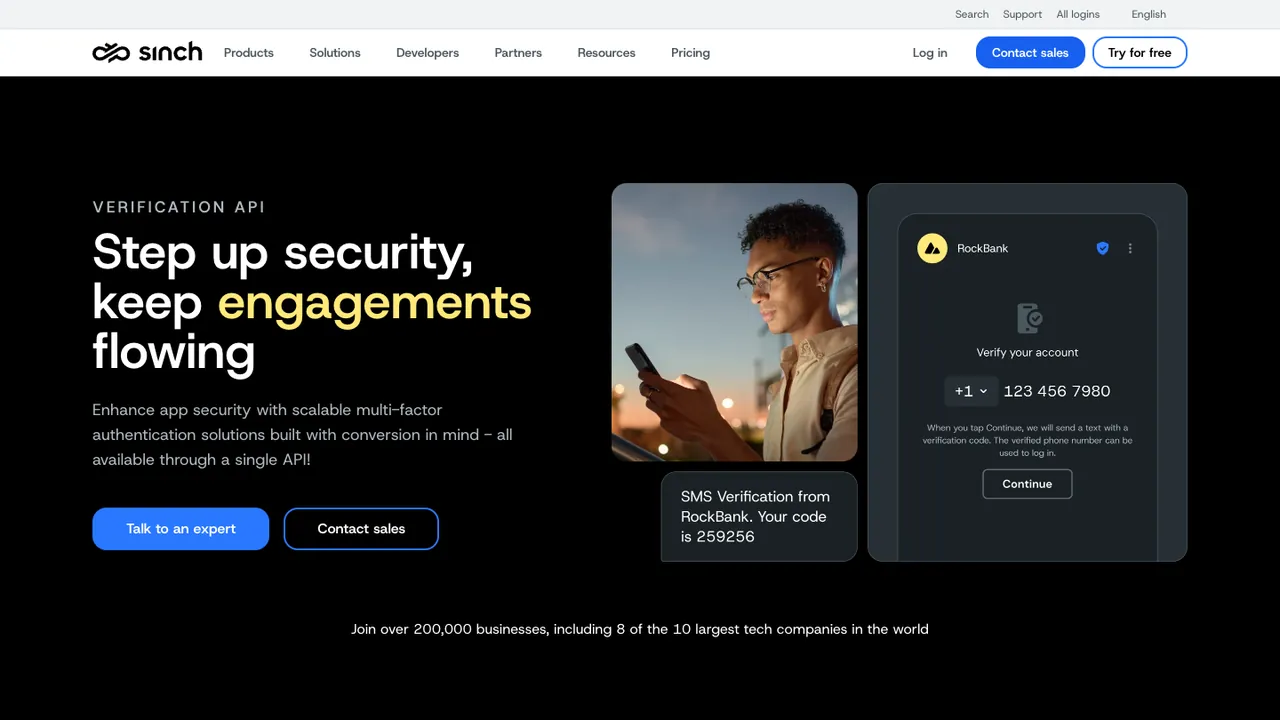
Sinch Verification supports SMS, voice calls, flash calls, and mobile-data verification. It also offers integrations with Auth0 and Okta for teams already using those authentication platforms.
Its Flash Call method verifies a phone number through a missed call, using the incoming caller number as the verification code.
On Android, the SDK can handle this automatically, reducing the need for users to switch applications and type a code. Flash Call can also support website verification, although the user experience depends on the device and implementation.
It also offers data verification, which removes the code-entry step entirely by checking the phone number through the mobile network. However, users must have mobile data enabled, and access requires contacting a Sinch account manager.
For mobile SDK integrations, Sinch requires callbacks to secure transactions. Its recommended implementation uses your backend to authorize verification requests, control retries, and receive the final verification result.
The dashboard reports delivery and conversion rates separately, helping your team distinguish between reaching a phone number and successfully verifying it.
Sinch documents request-based billing, charging for each Flash Call attempt and SMS rates that depend on the destination country and operator.
6. Infobip 2FA
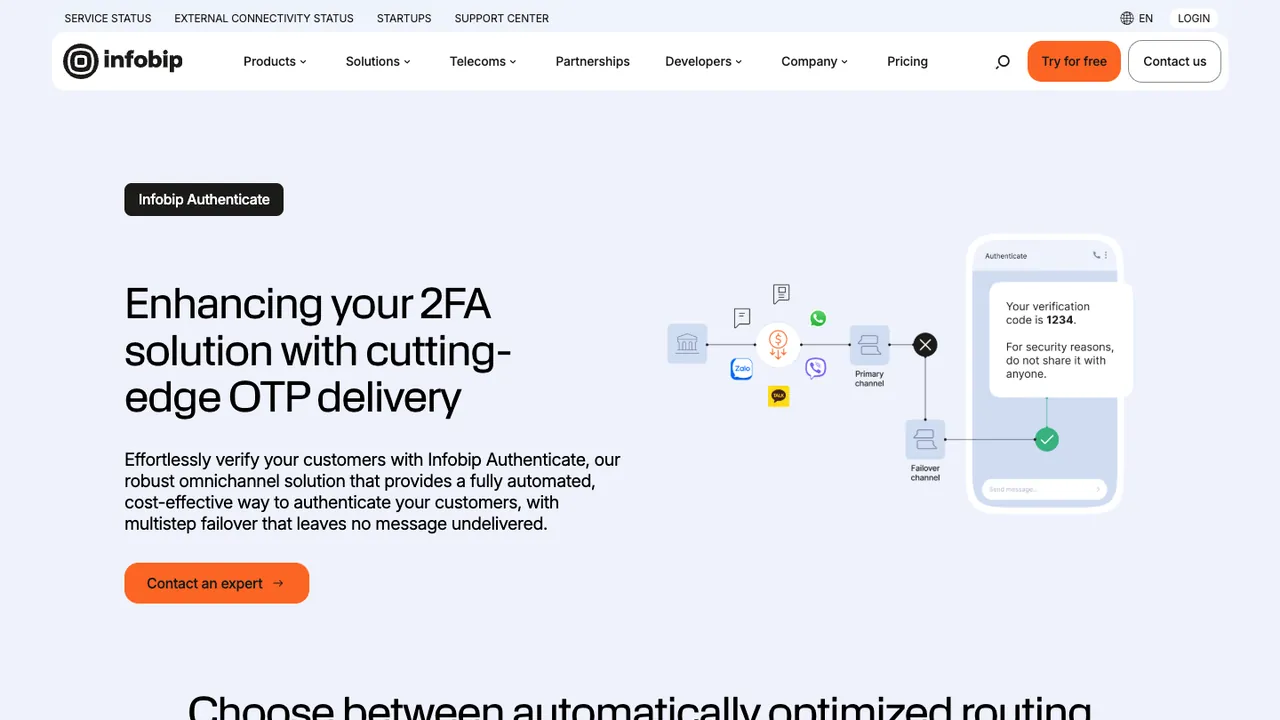
Infobip’s 2FA API generates, sends, and verifies OTPs through SMS, voice, and email. Your application requests a code, receives a PIN ID, and then submits that ID with the code the user entered for validation.
You can set code expiry, verification-attempt limits, and sending limits for individual phone numbers or the application as a whole. You can also create separate configurations to apply different rules to signup, password resets, or other verification flows, while multiple templates support different languages.
You also need to complete the setup for each delivery channel before sending live traffic, including configuring the sender and any additional channel requirements.
For teams that want automatic channel selection and fallback, Infobip also offers Authenticate, which advertises optimized routing across channels including SMS, WhatsApp, RCS, and Viber.
Infobip publishes channel-specific pricing, with SMS offered on a pay-as-you-go basis and rates varying by destination, network, and applicable discounts.
For a complete verification setup, request pricing for the specific 2FA or Authenticate offering you intend to use rather than treating its general SMS rate as the full OTP cost.
7. Prelude Verify
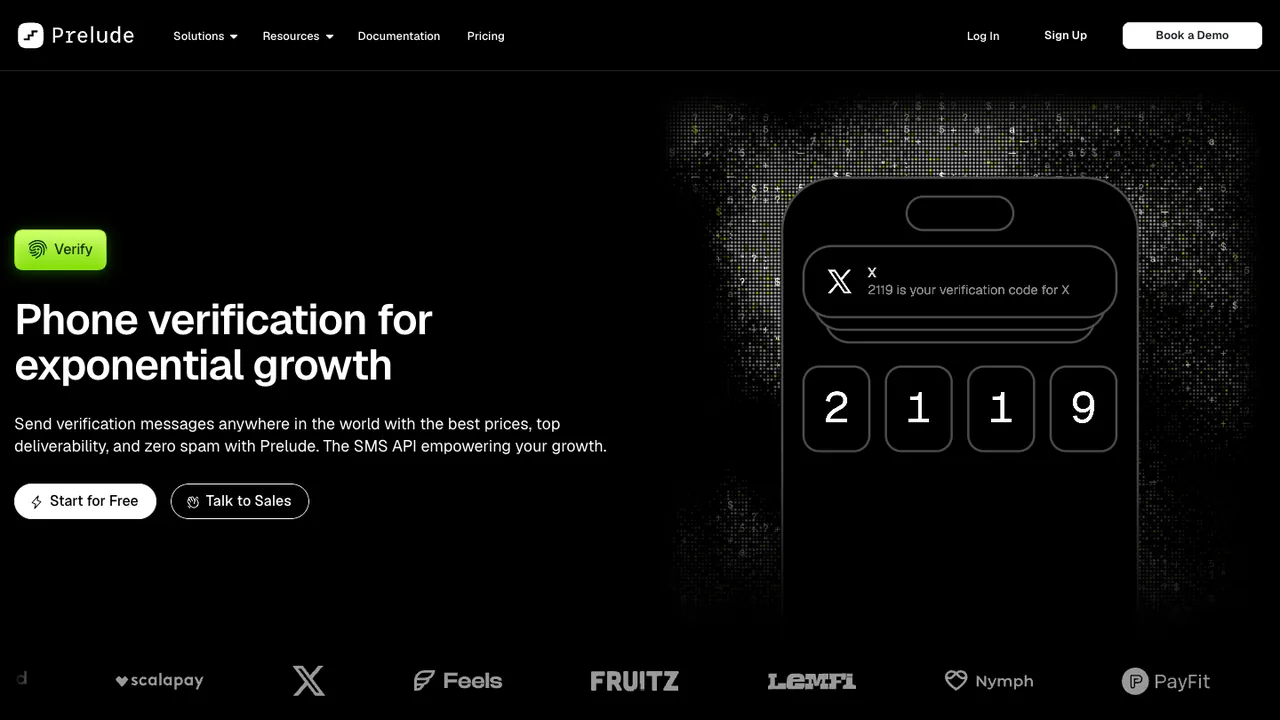
Prelude Verify handles phone and email verification, with delivery options including SMS, RCS, and WhatsApp. Its routing engine evaluates multiple providers and channels for each user, making it worth considering when your team wants to reduce the work of choosing and maintaining delivery routes across markets.
Prelude selects routes using both cost and verification-conversion data. Your team can set a country-specific preference to prioritize price, prioritize conversion, or balance the two. This gives you control over the trade-off without requiring your developers to select individual delivery providers for every request.
When delivery fails, or a user requests another code, Prelude chooses the next available route based on those criteria. A retry does not necessarily switch channels: it may use another SMS provider or move to a different channel entirely.
The basic integration uses separate requests to send and check a code, with backend SDKs available for several languages.
Prelude also recommends adding signals such as the user’s IP address and device information to verification requests to improve fraud detection. Your developers should include that work when preparing the integration for production.
Prelude’s current pay-as-you-go plan lists €0.032 per verification, plus message costs. The company says it passes through message charges without adding a markup, so the verification charge remains a separate part of your total cost.
The entry-level plan includes basic fraud protection and delivery reporting; its Startup plan adds advanced fraud protection, Slack support, and a longer data history. Enterprise pricing is available for committed volumes and additional support requirements.
Factors to Consider When Choosing an OTP Service Provider
When evaluating OTP service providers, start with the markets you serve and how much of the verification process you want your developers to manage.
From there, review what it takes to get users through verification successfully, how much that process costs, and what happens when delivery does not work as expected.
Deliverability in Your Target Markets
Check which channels are available in the countries where your users live, rather than relying on the total number of countries a provider advertises.
Also confirm whether those channels are available through the verification product you plan to use.
For example, RCS availability can depend on the country, network, and recipient’s device, while WhatsApp requires the recipient to use the app.
Before committing, test with real phone numbers across your main markets and networks. Record how long codes take to arrive and whether users can complete verification without requesting another code.
Also review results by country rather than treating an overall success rate as sufficient; country-level monitoring can help identify delivery issues that need investigation.
Channel Selection and Automatic Fallback
A configurable sequence gives you control over the channel order; dynamic routing can select routes using criteria such as cost and verification success.
Find out whether the provider follows a delivery sequence your team configures or evaluates available routes for each request. Both approaches can support automatic fallback, but they leave different responsibilities with your developers.
Ask exactly what triggers the next attempt. Does the provider switch when delivery fails, when no delivery confirmation arrives, or when the user has not entered the code within a specified time?
These are different situations, and the timing affects how long someone waits before receiving another attempt. Vonage, for example, lets teams configure a timeout for the user to complete verification before advancing through the workflow.
Also check whether a retry means switching channels or trying another delivery provider on the same channel.
The Total Cost of a Completed Verification
Depending on the service, your bill may include delivery charges and a separate successful-verification fee. Even wording such as “pay per successful verification” may still charge for the delivery attempts that did not result in verification.
Ask how the provider bills initial sends, retries, and fallback attempts. Then check minimum monthly commitments, paid support, and any additional charges for the fraud protection or routing features you need.
For your own evaluation, divide the total verification-related spend during a period by the number of completed verifications. Calculate this by market and across the application. That gives you a more useful budgeting figure than assuming every user will need exactly one message.
Also ask how the service controls costs after launch. Does it automatically evaluate lower-cost routes, or will your team need to review destination rates and update channel preferences?
Integration Work and Market Onboarding
A messaging API may leave code generation and validation to your application, while a verification API can handle those tasks.
Review the production integration, not just the quickstart. Check the available SDKs, server-side verification requirements, error handling, and how much retry logic your application must supply.
Also ask what happens when you add a country or delivery channel. Some destinations require sender registration or template setup, and those requirements can remain even when the API integration is already complete.
Establish who handles each step and allow time for approvals before scheduling a market launch.
Fraud Protection and Code Security
Look for controls that address SMS pumping, including limits on repeated requests, restrictions on unused destinations, and alerts for unusual spending or falling verification completion rates.
Confirm which protections are included and which you must configure on your side.
Provider-side fraud detection should support your application’s protections, not replace them. Your team still needs to control access to verification requests and handle abuse appropriately; no provider-side system can guarantee that it will block every attack.
Separately, check code expiry, limits on incorrect submissions, and whether a successfully used code can be reused.
Keep your application’s authentication requirements in mind, too: manually entered OTPs are not phishing-resistant, regardless of the delivery provider.
Reporting and Support When Something Goes Wrong
Your team should be able to investigate an individual verification without reconstructing it from a user’s complaint.
Look for searchable request histories showing the destination, channel, verification outcome, and relevant error details. Logs should help distinguish an expired code or attempt limit from a delivery problem.
At the application level, look for reporting by country and channel, alongside spending and completed-verification metrics. Alerts for unexpected usage or a drop in completion rates can help your team investigate problems before they affect more users.
Finally, confirm the support arrangements included in your plan. Ask who handles urgent delivery incidents, what response times are promised, and whether technical assistance costs extra.
Review production sending limits and the process for increasing them before a launch or traffic spike—not after users start having trouble receiving codes.
Send and Verify OTPs With SecondFactor
For apps and websites serving multiple markets that need to send and verify OTPs, you need reliable delivery and manageable costs, without leaving your developers responsible for continually adjusting channel selection and fallback workflows.
With SecondFactor, your application makes two API calls to send and verify codes. We handle code generation and validation, select the lowest-cost eligible channel across SMS, WhatsApp, Viber, and RCS, and automatically try another eligible channel when delivery is not confirmed.
Your team can use the same integration as you activate additional channels, rather than building separate delivery workflows.
Create your SecondFactor account to test the send-and-verify flow, or contact our team to discuss pricing for the markets you serve.