
Sinch Verification is a good option for businesses that need to verify phone numbers through SMS, voice calls, FlashCall, and mobile-network-based verification without building the entire verification system themselves.
However, these verification methods have different costs and availability requirements. SMS verification costs vary by country and operator, while FlashCall and mobile-network verification depend on device compatibility and carrier support.
For applications serving users across multiple markets, you may want a provider that supports additional channels such as WhatsApp, Viber, and RCS, automatically selects the lowest-cost eligible channel, and handles fallback when delivery isn’t confirmed.
In this article, we’ll share how our own OTP verification platform, SecondFactor, addresses these requirements, then cover seven other Sinch Verification alternatives whose names we often see come up.
1. SecondFactor
At SecondFactor, we help businesses send and verify OTPs across SMS, WhatsApp, Viber, and RCS through one API.
We built our platform for applications serving users across multiple countries, where delivery costs, channel availability, and verification requirements vary by market.
Our Price Intelligence Engine (PIE) automatically selects the lowest-cost eligible channel for each OTP request and handles fallback when delivery isn’t confirmed.
We also manage OTP generation, validation, and delivery tracking, so your developers don’t need to build and maintain separate verification workflows.
Send and Verify OTPs With One API Integration
With SecondFactor, your application uses two API endpoints to send and verify OTPs.
When a user requests a verification code, your application sends their phone number to our POST /v2/Services/{ServiceSid}/Verifications endpoint. We generate the OTP, select the delivery channel, and attempt delivery.
When the user enters the code, your application submits it through POST /v2/Services/{ServiceSid}/VerificationCheck. We validate the code and return the verification result.
The same integration works across SMS, WhatsApp, Viber, and RCS. You can add more channels without changing how your application sends or verifies OTPs.
Automatically Select the Lowest-Cost Eligible OTP Channel
Our Price Intelligence Engine evaluates the available delivery options for each OTP request rather than requiring you to maintain a fixed channel sequence.
PIE checks the destination country, operator, channel availability, recipient eligibility, and applicable delivery costs. It then selects the lowest-cost eligible channel.
For example, WhatsApp may cost less than SMS for a recipient in one country, while SMS or Viber may be the cheaper option in another market.
PIE makes these routing decisions automatically, so your developers don’t need to maintain country-specific rules or manually adjust channel preferences whenever delivery rates change.
Fall Back Automatically When OTP Delivery Isn’t Confirmed
If the selected channel doesn’t confirm delivery within eight seconds, SecondFactor automatically attempts the next eligible channel.
For example, if PIE initially selects WhatsApp because it offers a lower delivery cost but delivery isn’t confirmed, it can fall back to SMS when that channel is available.
We handle fallback within the same verification request. Your application doesn’t need to detect delivery failures, choose another channel, or trigger a separate OTP request.
This gives businesses another way to reach users without building and maintaining their own fallback workflows.
Manage OTP Channels and Authentication Templates
You can configure the delivery channels you want to use and manage authentication templates through the SecondFactor dashboard.
Some channels require additional setup. For example, WhatsApp requires a connected WhatsApp Business Account and approved authentication templates, while Viber and RCS may require business sender registration and approval.
Once you complete these requirements, PIE can include those channels when evaluating eligible delivery routes.
You can start with SMS and enable additional channels as your verification requirements expand into new markets.
Track OTP Delivery Status and Verification Costs
Our OTP logs show how verification requests are handled across different delivery channels.
You can review the destination country, recipient’s phone number, selected channel, delivery status, and cost of each request.
If a user reports that an OTP never arrived, your team can inspect the delivery record to see which channel was attempted and whether delivery was confirmed.
You can also use these records to understand how your OTP traffic is distributed across channels and how much each delivery attempt costs.
Test OTP Routing and Verification Before Integrating
We offer a PIE Playground where you can test OTP delivery and verification without writing integration code.
You can enter a phone number, send a real OTP, and see which channel PIE selected. The Playground also shows whether fallback occurred and lets you enter the received code to complete verification.
New accounts receive free credits to test the platform with their configured channels.
You can create a SecondFactor account to try the PIE Playground and see how our routing works for your target markets, or contact our team to discuss your verification requirements.
2. Twilio Verify
Twilio Verify is a managed verification API that lets businesses authenticate users via SMS, WhatsApp, voice calls, and email. It also supports TOTP, push notifications, and Silent Network Authentication (SNA).
The platform handles OTP generation, expiration, and validation, allowing developers to add phone verification to signup, login, and account recovery workflows without building these features themselves.
Twilio offers automatic channel selection and fallback capabilities. For example, it can upgrade eligible SMS verification requests to RCS and fall back to SMS when certain WhatsApp or RCS delivery failures occur. It also offers optional WhatsApp-first routing for selected countries, though access to some optimization features is limited.
For fraud prevention, Twilio includes Verify Fraud Guard to detect suspicious SMS traffic and help protect businesses against SMS pumping attacks. It also provides rate limiting, geographic permissions, verification logs, and reporting tools to monitor completion rates.
Twilio Verify uses a pay-as-you-go pricing model starting at $0.05 per successful verification, plus applicable channel delivery charges. SMS and voice attempts can still incur delivery costs even when users don’t complete verification.
3. Vonage Verify
Vonage Verify is a multichannel verification API that lets businesses send and validate OTPs via SMS, WhatsApp, RCS, voice calls, and email. It also supports Silent Authentication, which verifies phone numbers through mobile networks without requiring users to enter a code.
Vonage handles OTP generation, validation, and expiration through its Verify API. Developers can also supply their own verification codes and configure workflows that determine which channels to use and in what order.
For example, a business can configure a workflow that tries WhatsApp verification first, then SMS, and then voice if the user hasn’t completed verification. Developers can customize the time between attempts and the length of the verification code.
Vonage also offers Adaptive Routing to help route messages around network congestion and Fraud Defender to identify suspicious traffic, including artificially inflated SMS traffic. Its dashboard provides verification analytics broken down by channel, country, and mobile network.
Verify Conversion charges $0.06084 per successful verification plus applicable messaging and voice charges, including unsuccessful delivery attempts. Verify Success is an enterprise-oriented model with negotiated pricing that generally charges only for successful verifications.
4. Telesign Verify
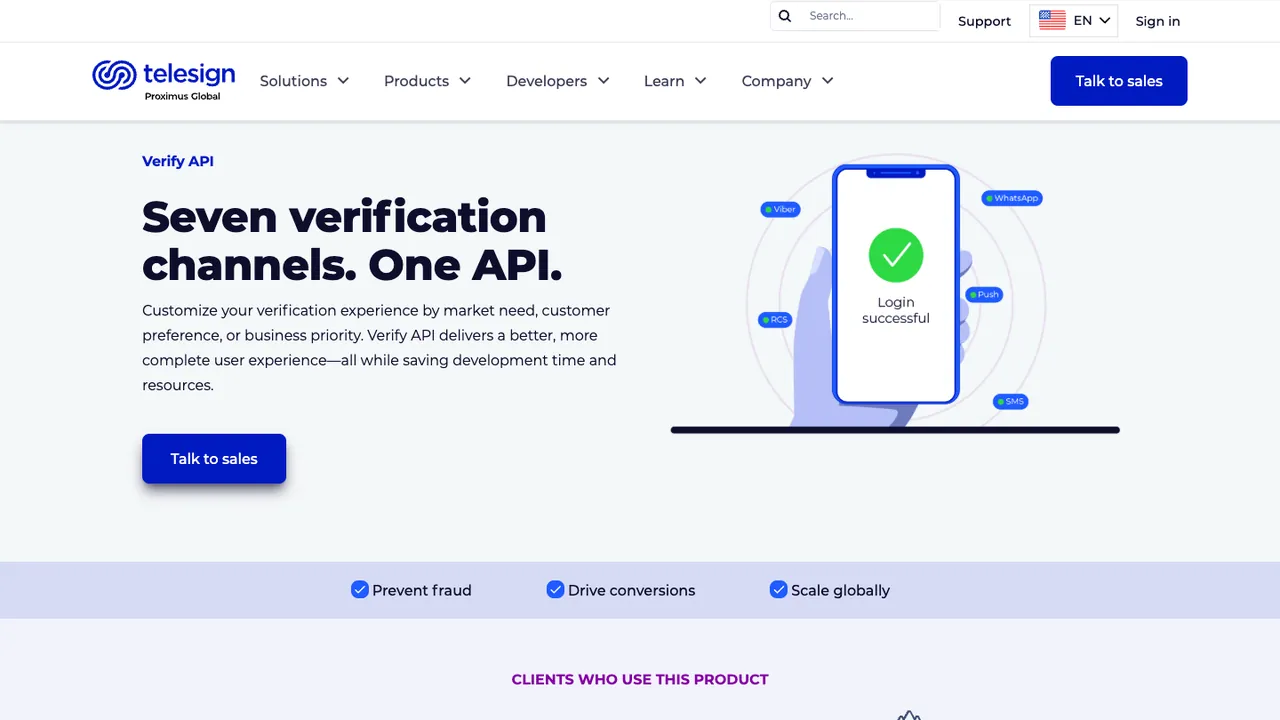
Telesign Verify is a multichannel verification API that lets businesses authenticate users through SMS, WhatsApp, Viber, RCS, email, and voice. It also supports Silent Verify, which uses mobile network information to verify phone numbers without requiring users to enter an OTP.
The platform handles OTP generation, delivery, and validation through one API. Developers can also supply their own verification codes and configure verification policies that determine which channels to use and when to attempt another method.
For example, a business can configure WhatsApp as its primary verification channel and SMS as a fallback. Telesign also supports country-specific routing rules, letting businesses prioritize different verification methods by destination market.
Its verification policies support up to three methods, with configurable fallback timing. Telesign also offers separate phone number intelligence and fraud prevention solutions to help businesses evaluate potentially risky users.
For applications currently using Sinch’s mobile-network-based verification, Telesign’s Silent Verify is worth considering. However, availability depends on the country and mobile operator.
Telesign Verify is available to full-service accounts, and businesses need to contact its team to enable the API.
5. Infobip Authenticate
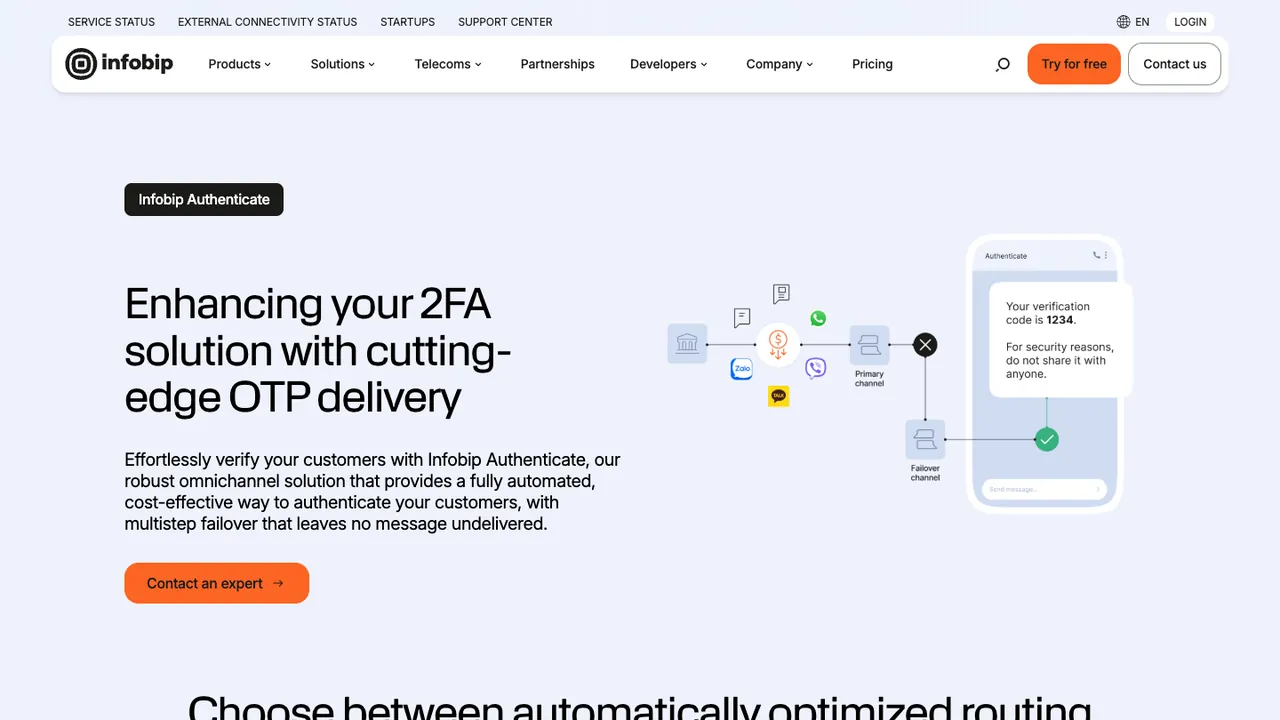
Infobip Authenticate is an omnichannel authentication solution that helps businesses send OTPs across SMS, WhatsApp, Viber, RCS, and other supported messaging channels.
One key feature is optimized routing, which automatically selects the best delivery channel for each recipient based on cost, channel availability, and delivery performance.
Infobip also supports multistep failover. If the platform can’t deliver an OTP through the initially selected channel, it can try another available channel without requiring developers to build separate fallback workflows.
Businesses can manage messaging templates, sender registrations, and channel configurations through the Infobip platform. Its analytics and delivery logs help teams monitor verification performance across different markets.
For fraud prevention, Infobip offers Signals, which detects suspicious messaging traffic and helps protect businesses against SMS pumping attacks.
Infobip also provides a separate 2FA API to generate and validate OTPs via SMS, voice, and email. Businesses evaluating its broader Authenticate solution should confirm which verification channels and features are included in their chosen configuration.
Infobip doesn’t publish a single standard price for Authenticate. Businesses need to contact its sales team for pricing based on their destinations, verification volume, and required channels.
6. Prelude Verify
Prelude Verify is a managed OTP verification API that helps businesses authenticate users across multiple messaging channels, including SMS, WhatsApp, RCS, Viber, Telegram, and voice.
The platform connects to more than 30 messaging providers and uses intelligent routing to select delivery routes based on factors such as cost, delivery performance, and availability. It supports verification across more than 230 regions.
Prelude also provides automatic fallback if the initial delivery route fails. Businesses can specify a preferred channel for individual requests or configure country-level routing preferences, including whether to prioritize delivery costs or conversion rates.
Its verification API handles OTP generation and validation, while its dashboard provides analytics on verification conversion rates, delivery performance, average costs, and time to verification.
For fraud prevention, Prelude uses automated risk detection to identify suspicious verification activity and help prevent SMS pumping attacks. Businesses can also configure more advanced fraud protection through its paid plans.
Prelude publishes its verification pricing, with its pay-as-you-go plan starting at €0.032 per verification plus applicable messaging costs. It also offers a Startup plan at €360 per month and custom enterprise pricing.
For businesses moving away from Sinch, Prelude is worth considering if automatic routing, multichannel delivery, and fraud prevention are priorities. However, teams using Sinch’s FlashCall or mobile-network-based verification should confirm whether Prelude supports the specific authentication methods they need.
7. Telnyx Verify
Telnyx Verify is a phone verification API that lets businesses authenticate users via SMS, voice calls, flash calls, and WhatsApp.
The platform handles OTP generation, delivery, expiration, and validation through its Verify API. Developers can create verification profiles to configure delivery methods, code expiration, and other settings.
Telnyx supports verification across more than 190 country codes. It also provides delivery reporting and analytics to help businesses monitor verification activity and troubleshoot failed attempts.
One feature is flash-call verification, which uses a phone call instead of SMS to verify a user’s number. This makes Telnyx particularly relevant for businesses currently using Sinch’s FlashCall verification method.
Telnyx also supports WhatsApp OTP delivery through approved authentication templates. To use this channel, businesses need a WhatsApp Business Account, an approved template, and a properly configured Verify profile.
Developers can select different verification methods and configure fallback workflows. However, businesses looking for automatic cost-based channel selection should evaluate how much additional routing logic they would need to implement.
Telnyx’s detailed pricing lists a $0.03 fee per successful verification, plus applicable SMS, voice, flash-call, or WhatsApp delivery charges. It offers pay-as-you-go access without a required monthly commitment, with volume discounts available for larger customers.
8. Plivo Verify
Plivo Verify is a managed OTP verification API that businesses can use to authenticate users through SMS and voice calls. Its website also advertises WhatsApp verification, although its current API documentation primarily covers SMS and voice.
The platform handles OTP generation, delivery, expiration, and validation through its Verify API. Developers can configure OTP length, expiration time, maximum delivery attempts, and message templates through the Plivo Console.
Plivo also supports delivery callbacks and verification logs that show the recipient, destination country, verification status, number of delivery attempts, and total session cost. Developers can implement fallback workflows that attempt voice verification if SMS delivery fails.
For fraud prevention, Plivo includes Fraud Shield, which monitors verification traffic for suspicious activity and helps prevent SMS pumping attacks. Businesses can configure different protection levels depending on their requirements.
Plivo doesn’t charge a separate OTP verification fee, and Fraud Shield is included at no additional cost. Businesses pay the applicable delivery costs based on the channel and destination country.
However, Plivo Verify is available only to eligible direct brands through sales-assisted onboarding. It requires a minimum monthly spend commitment of $1,000 for supported markets, increasing to $10,000 for access to countries that require sender or template pre-registration.
What to Consider When Choosing a Sinch Verification Alternative
Sinch already offers managed phone number verification, multiple verification methods, and delivery reporting.
When comparing alternatives, consider whether another provider can reduce your verification costs, support the channels your users need, and handle your existing verification workflows.
1. Total Cost per Successful Verification
Sinch charges for verification requests, with pricing depending on the method, destination country, and mobile operator.
Other providers may charge per successful verification, per delivery attempt, or a combination of verification and messaging fees.
Compare the total amount you spend to successfully verify a user rather than just the advertised cost of sending one OTP.
For example, an SMS verification may require multiple delivery attempts if the initial message doesn’t arrive. You may also incur additional charges when an OTP is resent through another channel.
These costs can add up quickly for applications processing thousands of verifications across different countries.
2. Supported OTP Channels and Verification Methods
Sinch supports SMS, phone calls, FlashCall, and mobile-network-based data verification. However, not every alternative offers the same methods.
Some providers support additional messaging channels, including WhatsApp, Viber, RCS, and email. These can give businesses more ways to reach users and potentially reduce delivery costs in certain markets.
Others support silent or network-based authentication, which can verify phone numbers without requiring users to enter a code.
If your application currently uses Sinch’s FlashCall or data verification, check whether the alternative supports those specific methods. An SMS or voice OTP API isn’t necessarily a direct replacement for these features.
3. Automatic Channel Selection and Fallback
Verification providers differ in how they choose the delivery channel and handle unsuccessful attempts.
Some require developers to configure a preferred channel sequence, while others can automatically select a channel based on destination, availability, pricing, or delivery performance.
For applications serving users in multiple markets, automatic channel selection can reduce the work required to maintain country-specific routing rules.
You should also check how fallback works. Find out what triggers another delivery attempt, how long the provider waits, which channels are eligible, and whether fallback messages incur additional charges.
Sinch supports switching between verification methods, so the comparison should focus on how much configuration and development work each provider requires.
4. Country Coverage and Delivery Requirements
A verification provider may support hundreds of countries, but delivery methods and costs can vary significantly by destination.
For example, SMS delivery may require sender ID registration or approved message templates in certain countries. WhatsApp, Viber, and RCS also have eligibility requirements that determine whether a particular recipient can receive an OTP through those channels.
Mobile-network-based verification methods have additional restrictions because they depend on supported carriers and device connectivity.
Before switching providers, confirm support for your highest-volume countries and test OTP delivery with real phone numbers.
Compare delivery confirmation rates, verification completion rates, delivery times, and costs rather than relying only on advertised geographic coverage.
5. Fraud Prevention and Verification Security
OTP verification endpoints can attract fraudulent traffic, particularly SMS pumping attacks that generate large numbers of verification requests to expensive destinations.
Look for providers that support rate limiting, suspicious traffic detection, country restrictions, OTP expiration, and limits on failed verification attempts.
You should also check whether these protections are included in the verification API or require separate products, configuration, or additional charges.
Delivery logs and verification analytics are also important. They help your team spot unusual traffic patterns, investigate failed verification attempts, and monitor spending across destinations.
6. API Integration and Migration Requirements
If you’re already using Sinch Verification, moving to another provider will require changes to how your application sends verification requests and checks their results.
Compare the new provider’s API endpoints, authentication requirements, SDKs, verification session handling, callbacks, and error responses.
If your application uses Sinch’s Android or iOS SDK for FlashCall or automatic code detection, switching to a messaging-based OTP API may also require changes to the user verification experience.
Before migrating all your traffic, test the new integration with a small group of users or a limited percentage of verification requests.
This gives you a chance to confirm verification works correctly, compare costs and completion rates, and identify issues before replacing your existing Sinch integration.
Reduce Your OTP Verification Costs With SecondFactor
At SecondFactor, we help businesses reduce OTP verification costs by automatically selecting the lowest-cost eligible channel across SMS, WhatsApp, Viber, and RCS. Our platform also handles fallback, OTP generation and validation, and delivery tracking through one API.
If you’re considering switching from Sinch, you can try our PIE Playground to see how SecondFactor routes OTPs across your target markets.
Get started with SecondFactor or contact our team to discuss your verification requirements.