
In our experience, sending an OTP gets harder, and more expensive as you add more countries, carriers, and users. The biggest challenges we see with OTP delivery and verification are failed messages that lead to retries, fraud that inflates traffic, and verification costs that end up well above the advertised price of an SMS.
SMS OTP service providers differ in their global coverage, delivery infrastructure, routing, fraud protection, fallback options, and APIs and these differences affect how quickly OTPs arrive, how many users complete verification, and how much each successful verification costs.
In this guide, we’ll explain how we handle SMS OTP delivery at SecondFactor, then look at eight other SMS OTP providers whose names we often see come up when teams are evaluating their options.
1. SecondFactor
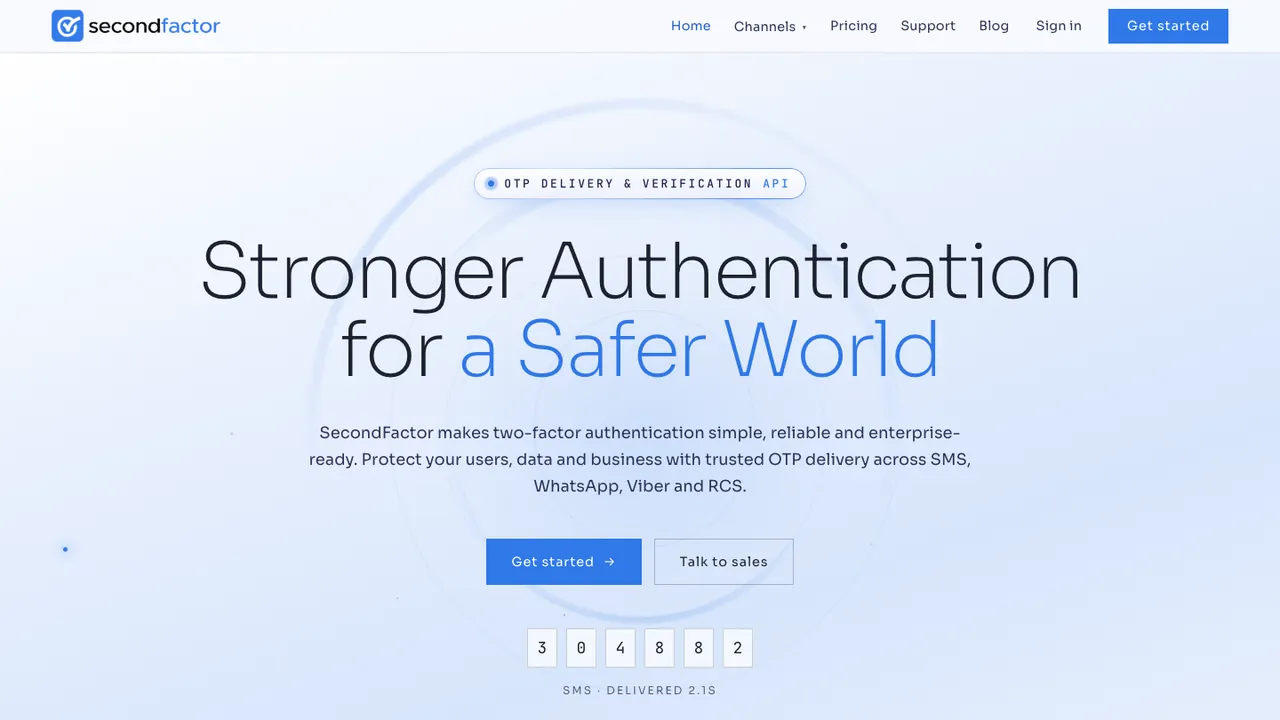
We built SecondFactor for teams that need to send OTPs across multiple countries without having to manage delivery routes, fallback, and verification logic themselves.
You can send SMS OTPs through SecondFactor, but SMS doesn’t have to be the only way you reach a user.
SecondFactor can also deliver OTPs through WhatsApp, Viber, and RCS when those channels are available.
Our Price Intelligence Engine (PIE) handles the routing between them, with the goal of getting each OTP delivered through the lowest-cost eligible channel.
Send and Verify OTPs With One Integration
With SecondFactor, you don’t need to build separate verification flows for SMS and every other channel you want to use.
Your application sends the user’s phone number to SecondFactor and we generate and deliver the OTP. When the user enters the code, your application sends it back to SecondFactor for verification.
We handle the code generation and validation, so you don’t need to store OTPs in your application.
You can also add supported delivery channels without rebuilding the verification flow for each one.
Route OTPs Through the Lowest-Cost Eligible Channel
SMS pricing can vary significantly depending on where you’re sending the OTP. And in some markets, SMS may not be the lowest-cost way to deliver a verification code.
Our Price Intelligence Engine checks the destination and the channels that are available for that request, then attempts delivery through the lowest-cost eligible option.
For example, if WhatsApp is available for a user and costs less than SMS in that market, PIE can try WhatsApp first. For another user or destination, SMS may be the better option.
This means your team doesn’t have to maintain its own country-by-country rules for deciding which channel to use.
Automatically Fall Back When an OTP Isn’t Delivered
Choosing a cheaper route only helps if the OTP actually reaches the user.
If delivery isn’t confirmed within eight seconds, SecondFactor automatically tries the next eligible channel. So if an OTP starts on WhatsApp and isn’t delivered, for example, the request can fall back to SMS when SMS is available.
Your developers don’t need to build separate logic to detect failed delivery, choose another channel, and resend the OTP.
See How Each OTP Was Delivered
When an OTP doesn’t arrive, knowing that a request was “sent” isn’t enough. You need to know which route was used and what happened.
SecondFactor’s OTP logs show the destination, channel, delivery status, and cost for each request. This lets you see how OTPs are being routed across your markets and investigate failed deliveries from the same place.
You can also use the PIE Playground to send a real OTP before integrating, see which route was selected, and test the verification flow yourself.
2. Twilio Verify
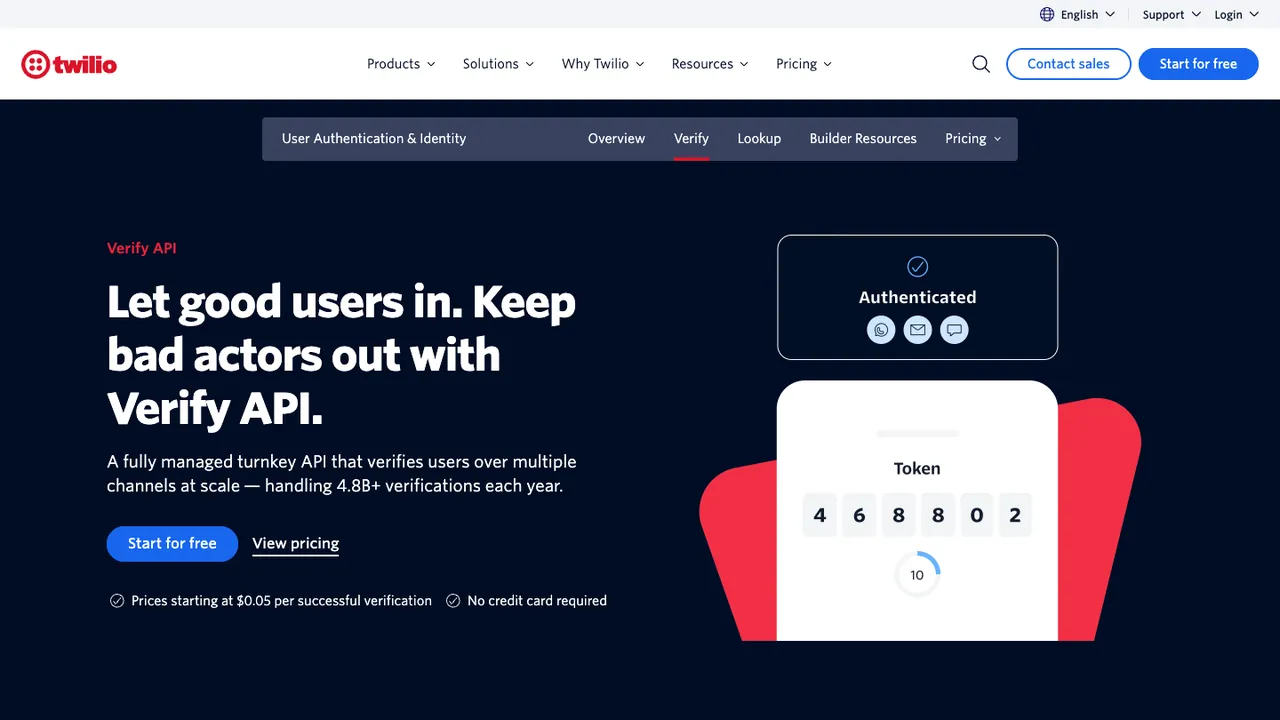
Twilio Verify is Twilio’s managed user verification product. It handles OTP generation and validation, delivery infrastructure, and fraud monitoring, so developers don’t have to build those parts of the verification flow themselves.
For SMS OTPs, you start a verification with the user’s phone number, and Twilio sends the code. Once the user enters the OTP, you use the Verification Check API to validate it.
Verify is available in more than 200 regions, and Twilio manages the sender IDs, phone numbers, carrier-approved templates, and routing used to deliver verification messages.
Twilio also supports other verification methods, including WhatsApp, voice, email, TOTP, push, and Silent Network Authentication (SNA). This gives teams options beyond SMS, although the channels available and their costs vary by market.
Twilio also provides Fraud Guard that looks for unusual traffic patterns and can automatically block verification attempts that appear to be SMS pumping. You can choose different protection levels depending on how aggressively you want Twilio to block suspicious traffic.
Twilio Verify currently charges $0.05 per successful verification, plus the cost of the channel used. For SMS, message attempts are charged whether or not the message is delivered.
3. Plivo Verify
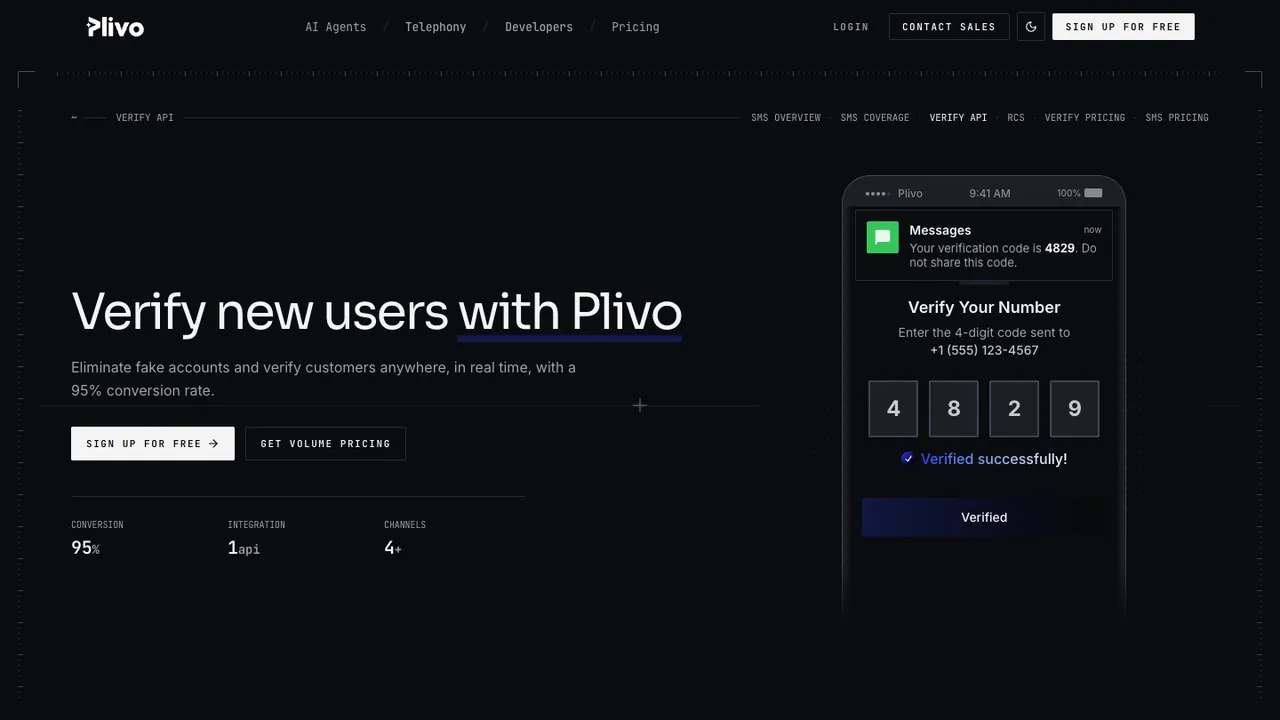
Plivo Verify is a managed OTP service for sending and validating verification codes over SMS, voice, and WhatsApp. Like Twilio Verify, it handles OTP generation and validation, so you can add phone verification without building the full OTP lifecycle yourself.
A verification starts by sending the recipient’s phone number and delivery channel to the Verify API. Plivo generates the OTP and creates a verification session, and you use its Validate Session API to check the code entered by the user. You can also receive delivery status updates through webhooks.
Plivo includes Fraud Shield for detecting SMS pumping. It monitors verification traffic and blocks messages it considers suspicious, with high, medium, and low protection levels depending on how aggressively you want it to filter traffic.
Plivo Verify is currently offered to direct brands rather than resellers or ISVs, and access requires a minimum monthly commitment. A $1,000 monthly commitment covers the US, Canada, UK, Australia, India through ILDO routes, and countries that don’t require pre-registration. A $10,000 commitment adds markets where sender or brand registration is required.
Plivo doesn’t charge a separate verification fee, so you pay only the SMS, voice, or WhatsApp charges for the messages and calls used.
Plivo’s Verify product page lists SMS, voice, and WhatsApp, while its Verify availability documentation describes delivery over SMS and voice. If you plan to use WhatsApp, confirm that it’s enabled for your account.
4. Vonage Verify
Vonage Verify is a managed verification API for sending and validating OTPs across multiple channels. It can generate and manage the OTP for you, or you can use your own codes.
For SMS verification, you create a verification request with the user’s phone number and define the workflow you want Vonage to follow. The user receives the OTP and enters it in your application, which then sends the code to Vonage for verification.
Vonage lets you configure workflows that specify which channels to use and the order to try them. For example, you can start with SMS and fall back to a voice call if the first verification attempt doesn’t complete. Supported channels include SMS, RCS, WhatsApp, voice, email, and Silent Authentication.
Verify also includes Fraud Defender Advanced, which provides protection against Artificially Inflated Traffic (AIT), SMS pumping, and other suspicious verification traffic. Vonage includes this protection with the Verify API at no additional cost.
Vonage offers two pricing models for Verify. Verify Conversion charges $0.06084 per successful verification, with messaging and voice charges added separately.
Verify Success uses custom pricing and charges only when a user successfully completes verification, including the messaging or voice attempts used during the process.
5. Sinch Verification
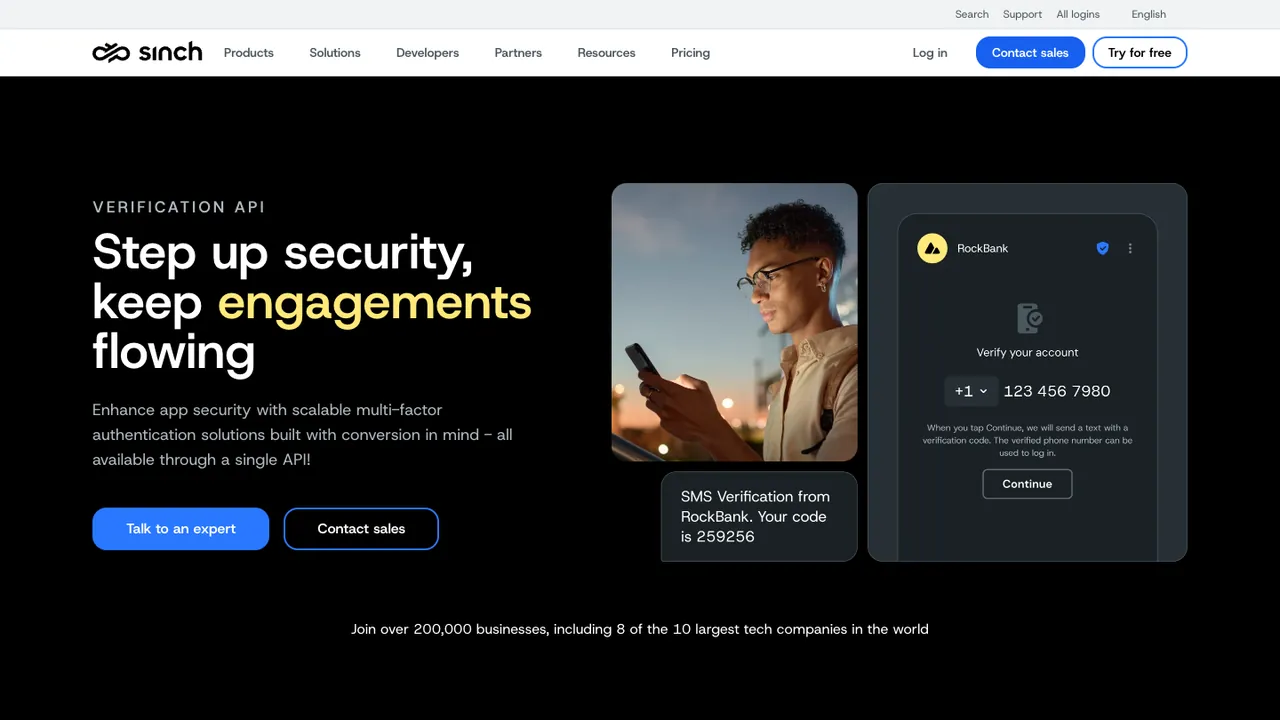
Sinch Verification provides phone number verification through SMS, flash calls, phone calls, and data verification. You can use its REST API directly or integrate its SDKs into Android, iOS, and web applications.
For SMS verification, Sinch sends an OTP to the user’s phone number and checks the code your application returns. On Android, the Sinch SDK can also detect the verification SMS and submit the OTP automatically when the required permissions are available.
Sinch also offers flash call verification, where the user receives a missed call instead of an SMS, and phone call verification, where the OTP is delivered by voice. Its data verification method uses mobile carrier infrastructure to verify the phone number without requiring the user to enter a code, although Sinch says this method has limited coverage and requires contacting an account manager.
The Sinch dashboard reports delivery and conversion rates for verification attempts. Delivery rate measures whether the phone could be reached or the SMS was delivered, while conversion rate measures the percentage of unique phone numbers that successfully completed verification.
Sinch charges for verification attempts based on the method used. For SMS, the price depends on the destination country and operator, and Sinch charges for each SMS verification attempt.
6. Infobip
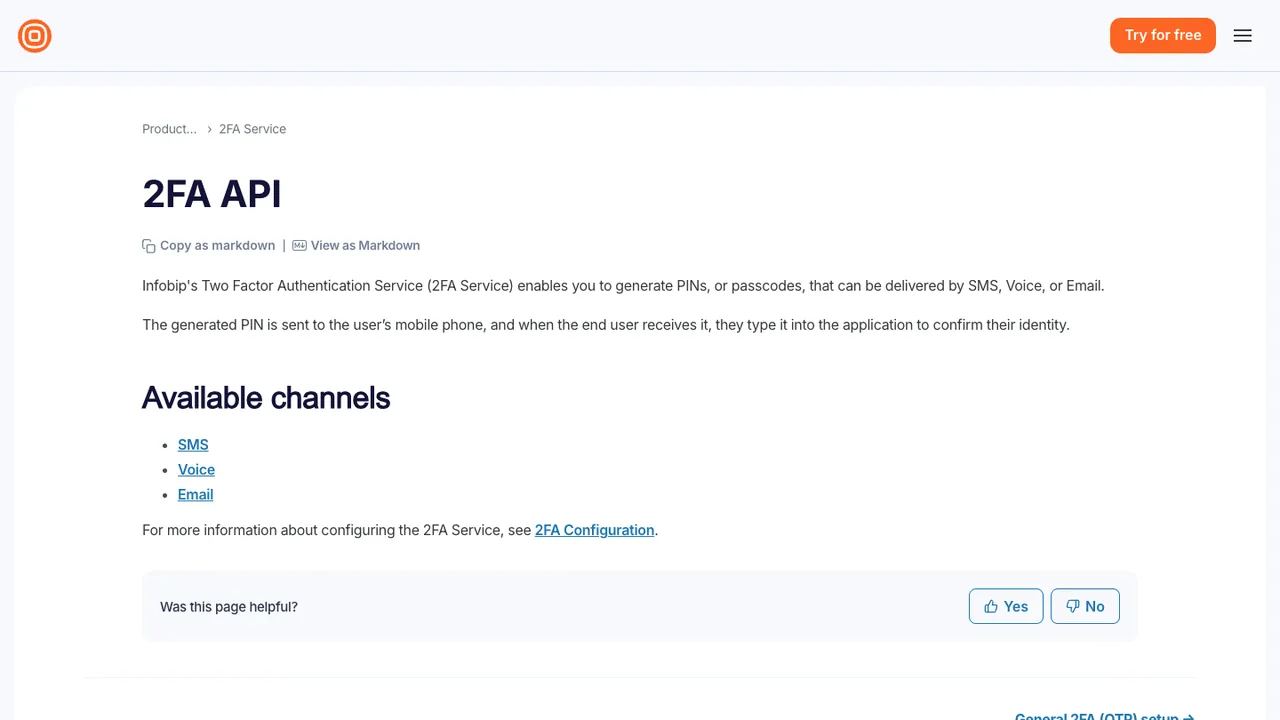
Infobip provides a 2FA API for generating, sending, and verifying OTPs. The service supports OTP delivery through SMS, voice, and email.
For SMS verification, you first configure a 2FA application and message template. When you make a request with the user’s phone number, Infobip generates a PIN and sends it using the configured template. You then submit the PIN entered by the user to Infobip for verification.
Infobip lets you configure settings such as PIN length, PIN type, validity period, and the number of verification attempts allowed. Its APIs can also return delivery and verification information that you can use to track individual authentication attempts.
Infobip has its own global messaging infrastructure and offers SMS pricing based on the destination country and message volume.
SMS is available on a pay-as-you-go basis, with custom plans available for higher-volume customers.
7. Telesign Verify
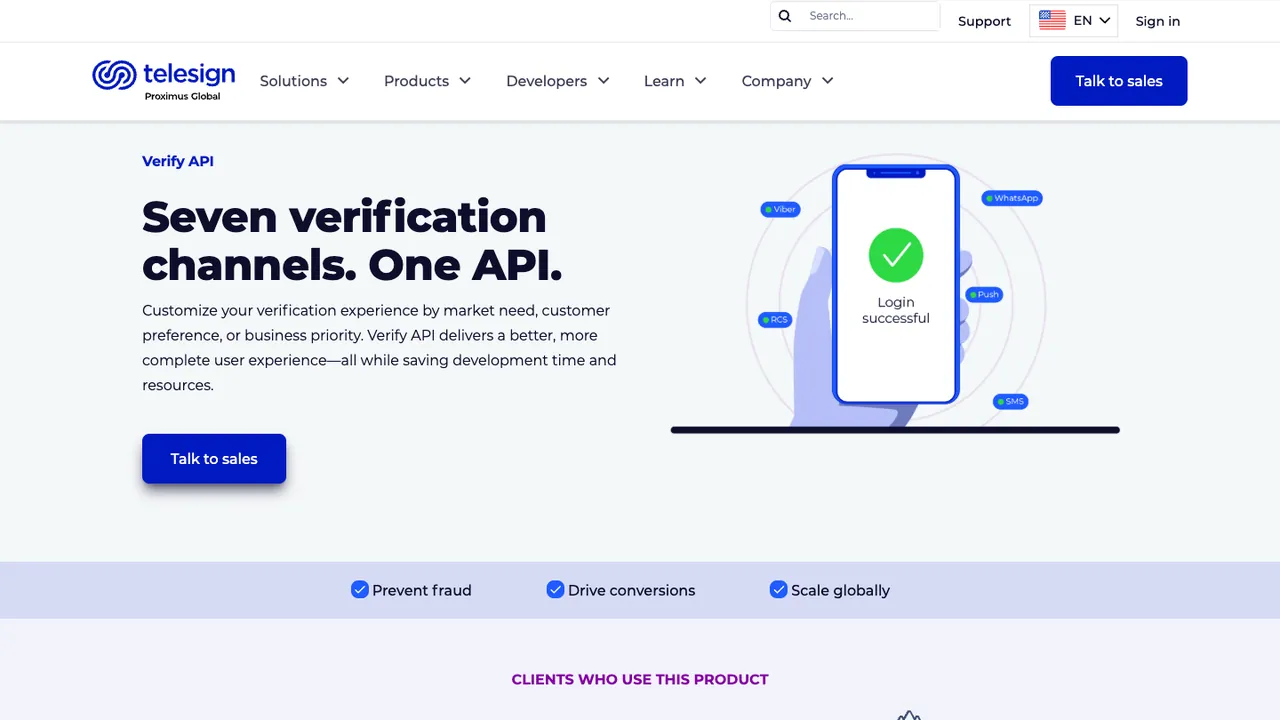
Telesign Verify is a managed verification API that supports SMS, WhatsApp, Viber, RCS, email, voice, push, and Silent Verification. You can use a Telesign-generated OTP or provide your own code.
For SMS OTPs, you create a verification request with the user’s phone number, and Telesign sends the code. After the user enters the OTP, you complete the verification request with Telesign to confirm whether the code is correct.
Telesign lets you create verification policies that define which channels to use and when to fall back to another. For example, a request can start with WhatsApp and automatically fall back to SMS after a set period if the first attempt fails.
Telesign also supports region-specific verification policies, so you can choose different methods by market. Its Verify API includes multichannel fallback to secondary and tertiary verification methods when the first channel is unsuccessful.
Telesign’s verification pricing varies by verification method and destination country. It offers pay-as-you-go, volume, and committed-use pricing.
8. Prelude Verify
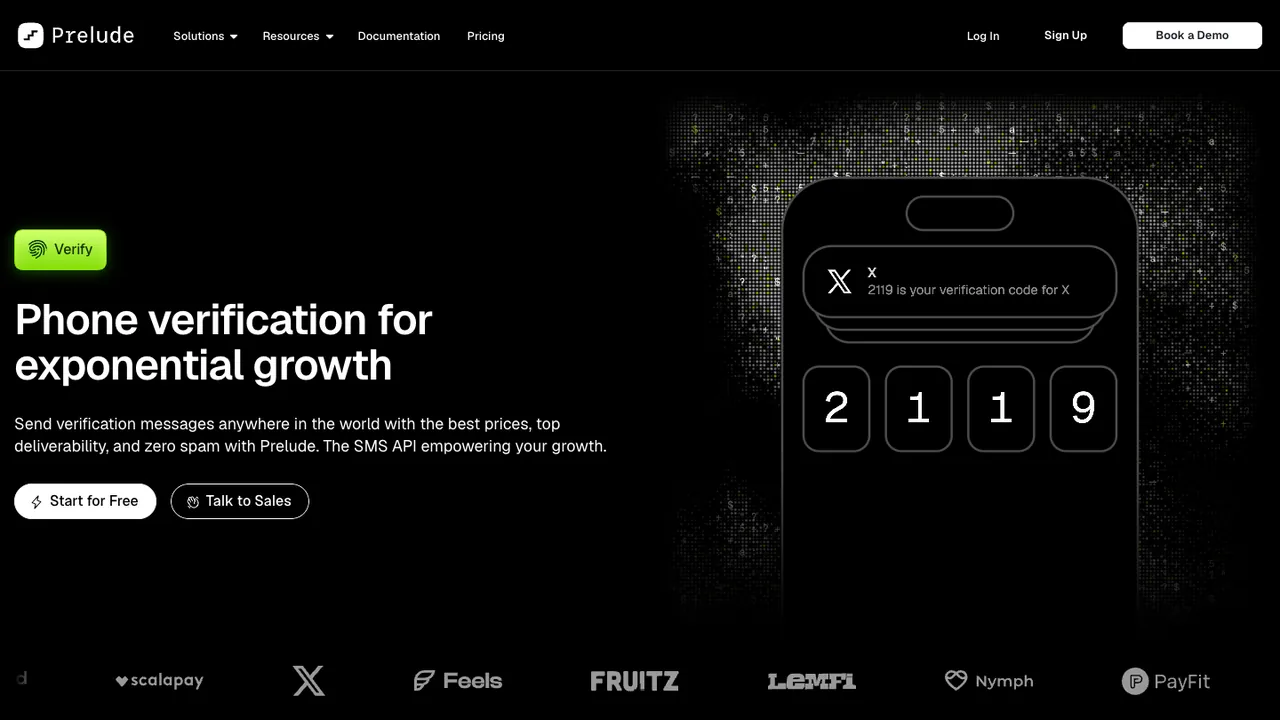
Prelude Verify is an OTP verification API that supports SMS, WhatsApp, RCS, Viber, Zalo, voice, and email. Prelude says its verification network covers more than 230 regions.
For SMS OTPs, you send the user’s phone number to the Verification API, and Prelude handles code generation and delivery. Its API uses two main endpoints: one to start verification and another to check the code the user enters.
Prelude routes verification traffic across different providers and channels. You can configure routing by country to prioritize price, conversion rate, or a balance of both.
You can also enable messaging channels such as WhatsApp, RCS, Viber, and Zalo alongside SMS.
Prelude includes fraud protection and observability with its Verify plans, with advanced antifraud features available on its Startup plan.
Its current pay-as-you-go plan costs €0.032 per verification plus message costs. Prelude says it passes through messaging costs without adding a markup.
9. MSG91
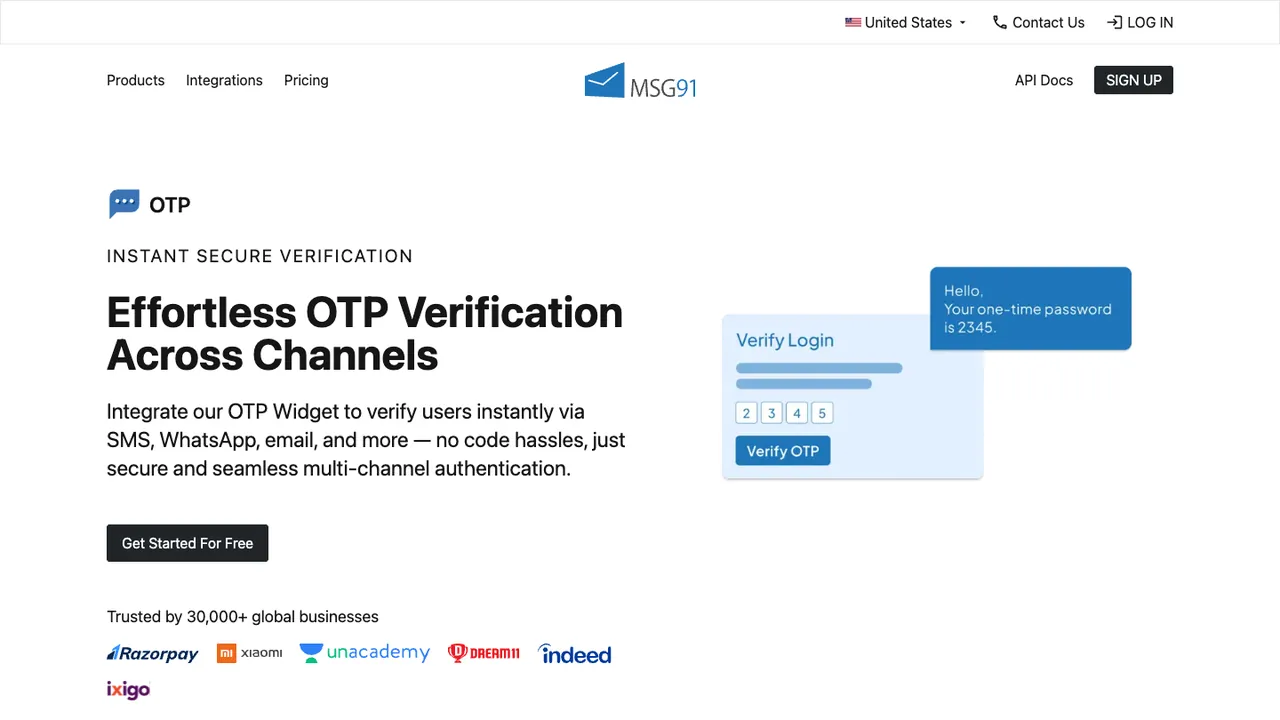
MSG91 provides APIs and an OTP Widget for sending and verifying OTPs. Its OTP APIs support generating an OTP, verifying the code the user enters, resending an OTP, managing templates, and retrieving OTP logs and analytics.
For SMS OTPs, you send the user’s phone number and an OTP template ID to the SendOTP API. MSG91 generates and sends the OTP, and you can then use the Verify OTP API to check the code the user entered.
You can also provide your own OTP instead of having MSG91 generate one.
MSG91 also provides an OTP Widget that handles the send, retry, and verification flow and returns a JWT access token after a successful verification.
The widget supports SMS, email, voice, and Invisible OTP, while MSG91 also provides WhatsApp authentication separately.
MSG91 publishes country-specific OTP rates. For example, its current pricing page lists SMS OTPs sent from the US to US numbers at $0.0096 per OTP. OTP Widget usage itself is free, with charges applied for the channels used to deliver OTPs.
Factors to Consider When Choosing an SMS OTP Service Provider
The right SMS OTP provider depends on where your users are, how much verification traffic you send, and what happens when the first OTP attempt fails.
Here are the main factors we recommend looking at when comparing providers.
Delivery Rates in Your Key Markets
Global coverage doesn’t necessarily mean the same delivery performance in every country. OTP delivery can vary by carrier, route, sender type, and local messaging requirements.
Look at delivery and verification rates in the countries where you actually have users. If a provider offers delivery logs or country-level reporting, you can use that data to see where messages are failing or taking longer to arrive.
If your verification volume can spike during signups, campaigns, or product launches, check whether the provider can handle those increases without affecting delivery times.
Cost per Successful Verification
The price of sending one SMS doesn’t tell you how much it costs to verify a user.
If an OTP isn’t delivered, you may pay for the original message and one or more retries. Some providers also charge a separate verification fee on top of messaging costs.
We recommend comparing providers based on how much you spend for each successful verification, rather than the advertised cost of an SMS. At higher volumes, also check whether the provider offers volume discounts or committed-use pricing.
Routing and Fallback
Check what happens when the first OTP doesn’t reach the user. Some providers let you configure a sequence of channels, while others require you to manage retries and fallback in your own application.
If you operate across multiple countries, also consider whether routing can change based on destination, delivery performance, or cost, rather than using the same route for every verification.
Fraud Protection
SMS pumping can generate large volumes of verification requests to numbers controlled by fraudsters, leaving you to pay for messages that were never intended for real users.
Look at whether the provider detects unusual verification traffic, blocks suspicious requests automatically, and gives you controls for adjusting how aggressively those requests are filtered.
Security and compliance requirements also depend on what you’re using OTPs for and where you operate.
Check the provider’s security practices, data handling, certifications, and support for any regulatory requirements that apply to your business.
Supported Verification Channels
SMS has broad reach, but it doesn’t have to be the only way you deliver an OTP. Providers may also support WhatsApp, RCS, Viber, voice, email, or carrier-based verification methods.
If you plan to use more than one channel, check whether you can manage them through the same verification API and whether the provider can automatically fall back between them.
API and Developer Experience
Look at what your team needs to build beyond the initial API call. This includes OTP generation and validation, expiration, retries, delivery status, fallback logic, webhooks, and fraud controls.
SDK availability, documentation, test environments, and logs also matter when you’re integrating the service and debugging failed verification attempts.
For production systems, check what technical support is available when delivery problems can’t be resolved from the logs alone.
Send SMS OTPs With SecondFactor
The SMS OTP provider you choose affects more than the price of each message. Delivery failures, retries, fraud, and the routes used to reach users all contribute to how much you ultimately spend on each successful verification.
At SecondFactor, we built our OTP API to handle this routing for you. Our Price Intelligence Engine finds the lowest-cost eligible channel for each OTP and automatically falls back to another channel if the first attempt isn’t delivered.
You can use one API to send and verify OTPs across SMS, WhatsApp, Viber, and RCS, without building separate routing and fallback logic for each channel.